

Mathematics Past Questions And Answers
In the diagram, PQ is parallel to RS, ∠QFG = 105° and ∠FEG = 50°. Find the value of n
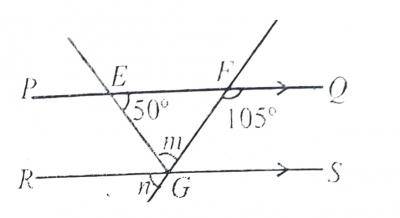
- A. 40°
- B. 55°
- C. 75°
- D. 130°
Find the fourth term in the expansion of \((3x - y)^{6}\).
- A. \(-540x^{3}y^{3}\)
- B. \(-540x^{4}y^{2}\)
- C. \(-27x^{3}y^{3}\)
- D. \(540x^{4}y^{2}\)
A particle is under the action of forces \(P = (4N, 030°)\) and \(R = (10N, 300°)\). Find the force that will keep the particle in equilibrium.
View Discussion (0)WAEC 2013 THEORYIf \(\frac{1}{2}\)x + 2y = 3 and \(\frac{3}{2}\)x and \(\frac{3}{2}\)x - 2y = 1, find (x + y)
- A. 3
- B. 2
- C. 1
- D. 5
(a) Without using calculator or tables, find the value of \(\log 3.6\) given that \(\log 2 = 0.3010, \log 3 = 0.4771\) and \(\log 5 = 0.6990\).
(b) If all numbers in the equation \(\frac{y}{y + 101} = \frac{11}{10010}\) are in base two, solve for y.
(a) Without using calculator or tables, find the value of \(\log 3.6\) given that \(\log 2 = 0.3010, \log 3 = 0.4771\) and \(\log 5 = 0.6990\).
(b) If all numbers in the equation \(\frac{y}{y + 101} = \frac{11}{10010}\) are in base two, solve for y.
View Discussion (0)WAEC 2008 THEORYIn the diagram, |SR| = |RQ| and ∠PRQ = 58° ∠VQT = 19°, PQT, SQV and PSR are straight lines. Find ∠QPS
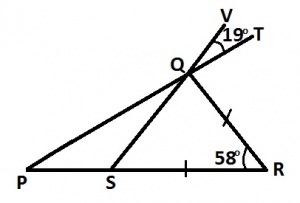
- A. 42°
- B. 39°
- C. 38°
- D. 30°
The bar chart shows the marks distribution in am English test. If 50% is the pass mark, how many students passed the test?

- A. 100
- B. 85
- C. 80
- D. 70
Find \(\lim\limits_{x \to 3} \frac{2x^{2} + x - 21}{x - 3}\).
- A. 0
- B. 1
- C. 7
- D. 13
(a) If \(f(x + 2) = 6x^{2} + 5x - 8\), find \(f(5)\).
(b) Express \(\frac{7\sqrt{2} + 3\sqrt{3}}{4\sqrt{2} - 2\sqrt{3}}\) in the form \(p + q\sqrt{r}\), where p, q and r are rational numbers.
View Discussion (0)WAEC 2016 THEORYThe bearings of P and Q from a common point N are 020° and 300° respectively. If P and Q are also equidistant from N, find the bearing of P from Q.
- A. 040°
- B. 070°
- C. 280°
- D. 320°