

Chemistry Past Questions And Answers
How many structural isomers of chlorobutane are possible?
- A. 4
- B. 3
- C. 2
- D. 1
(a) Give one example each of a naturally occurring substance that;
(i) conforms to the general formula C\(_x\)(H\(_2\)O)\(_y\);
(ii) contains the carboxyl group as its functional group.
(b) Name the process for obtaining: (i) paraffin oil from crude oil; (ii) benzene from ethyne.
View Discussion (0)WAEC 1994 THEORYwhich of the following solutions containing one mole per dm3 of the compound would have the lowest PH?
- A. ethanoic acid
- B. hydrochloric acid
- C. sodium chloride
- D. sodium hydrogentrioxocarbonate(iv)
The number of electrons in the valence shell of an element of atomic number 14 is?
- A. 1
- B. 2
- C. 3
- D. 4
Choose the correct option from the structure below
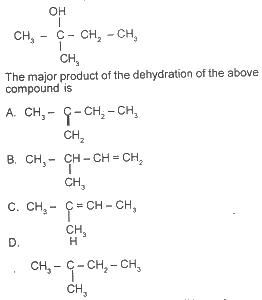
- A. A
- B. B
- C. C
- D. D
Which process(es) is/are involved in the turning of starch iodide paper blue-black by chlorine gas?
- A) chlorine attacks the starch to give the blue-black color
- B) chlorine attacks the iodide ion to give the blue-black color
- C) chlorine oxidizes the iodide ion to produce iodine which attacks the starch to give the blue-black color
- D) iodine attacks the starch to give the blue-black color
A hydrocarbon has an empirical formula CH and a vapour density of 39. Determine its molecular formula.[C = 12, H = 1]
- A) C2H6
- B) C3H8
- C) C3H4
- D) C6H6
In the laboratory preparation of oxygen, dried oxygen is usually collected over
- A) hydrochloric acid
- B) mercury
- C) calcium chloride
- D) tetraoxosulphate (VI) acid
Which of the following factors does not affect the rate of reaction of CaCO3 with HCI?
- A. temperature of the reaction
- B. solubility of the CaCO3
- C. concentration of the HCI
- D. surface area of the CaCO3
The condensation of several amino acid molecules gives
- A. long chain alkanoic acids
- B. secondary alkanols
- C. alkanoates
- D. proteins