

Chemistry Past Questions And Answers
The volume occupied by 17g of H2S at s.t.p. is [H = 1.00, S = 32.0, Molar volume = 22.4 dm3]
- A. 11.2dm3
- B. 17.0 dm3
- C. 34.0dm3
- D. 44.8dm3
The loss of molecules of water of crystallization to the atmosphere by some crystalline salts is known as
- A. efflorescence
- B. effervescence
- C. phosphorescence
- D. fluorescence
POlyvinyl chloride is used to produce
- A. bread
- B. pencils
- C. ink
- D. pipes
Potassium trioxonitrate (V) can be obtained from its solution by----------
- A. distillation
- B. evaporation
- C. crystallization
- D. filtration
How many isomers of the compound below can be obtained?
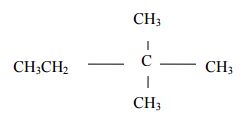
- A) 5
- B) 4
- C) 3
- D) 2
Which of the following statement is correct? The solubility of
- A. gases increases with increase in temperature
- B. gases decreases with increase in temperature
- C. most solid solutes decreases with indease in temperature
- D. most solid solutes is constant
The ideal gas equation is ______
- A) PV = nRT
- B) PR = nVT
- C) PV = gRT
- D) V = kT
(a) State three postulates of the kinetic theory
(b) Name the process involved in the;
(i) spread of the smell of a perfume across a room
(ii) decrease in the yellow of a liquid after exposure in an open vessel.
View Discussion (0)WAEC 1996 THEORY35 cm3 of hydrogen was sparked with 12 cm3 of oxygen at 110°C and 760mm Hg to produce steam. What percentage of the total volume of gas left after the reaction is hydrogen?
- A. 11%
- B. 31%
- C. 35%
- D. 69%
(a) Describe briefly a suitable procedure for preparing a pure sample of MgSO\(_4\) starting from MgO.
(b)(i) Mention two sources of water pollution.
(ii) Explain why the sample of air collected in the process of boiling water is richer in oxygen than atmospheric air
(iii) Mention one substance used as coagulant in water treatment plants.
(c)(i) State two physical porperties of chlorine.
(ii) Write an equation to show how chlorine reacts with iron
(iii) Why is Chlorine preferred to sulphur (IV) oxide in the bleaching of cotton
(d) Bleaching powder reacts with dilute HCl according to the reaction below;
CaOCl\(_{2(s)}\) + 2HCI\(_{(aq)}\) -> CaCl\(_{2(aq)}\) + H\(_2\)O\(_{(l)}\) + Cl\(_{2(g)}\)
Calculate the mass of bleaching powder that will produce 400cm\(^3\) of chlorine at 25\(^o\)C and a pressure of 1.20 x 10\(^5\) NM\(^{-2}\). [O = 16.0; Cl = 35.5; Ca = 40.0;1 mole of gas occupies 22.4 dm\(^3\) at s.t.p; standard pressure = 1.01 x 10\(^6\) Nm\(^{-2}\)]
View Discussion (0)WAEC 2001 THEORY