

Chemistry Past Questions And Answers
What are the possible oxidation numbers of an element if its atomic number is 17?
- A. -1 and 7
- B. -1 and 6
- C. -3 and 5
- D. -2 and 6
The molarity of 5% by weight of aqueous solution of tetraoxosulphate(VI) acid [molecular weight = 98] is
- A) 0.537 moldm?3
- B) 0.208 moldm?3
- C) 0.551 moldm?3
- D) 0.333 moldm?3
Considered the reaction: H+(aq) + OH- (aq) → H2O (l). The energy change taking place in the reaction above is enthalpy of
- A. formation
- B. hydration
- C. neutralization
- D. solution
Which is the temperature of a given mass of a gas initially at 0°C and 9 atm, if the pressure is reduced to 3 atm at constant volume?
- A. 91K
- B. 182K
- C. 273K
- D. 819K
One advantages of detergents over soap is that detergents?
- A. are easier to maufacture
- B. foam more than soap
- C. form soluble salts with hard water
- D. are able to deter germs more than soap
The most common ores of iron include
- A. haematite, malachite and limonite
- B. chalcolite, calamine and bornite
- C. magnetite, haematite and bornite
- D. magnetite, chalcolite and bornite
Choose the correct answer in the option above. Which of the following is a primary amine?
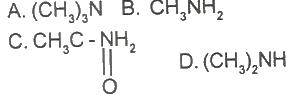
- A) A
- B) B
- C) C
- D) D
50cm\(^3\) of a saturated solution of KNO\(_3\) at 40\(^{\circ}\)C contained 5.05g of the salt. What is the solubility of KNO\(_3\) at 40\(^{\circ}\)C [K = 39, N = 14, O = 16]
- A)1.0moldm\(^{-3}\)
- B)1.5moldm\(^{-3}\)
- C)2.0moldm\(^{-3}\)
- D)5.0moldm\(^{-3}\)
Carbon exist naturally in the combined state as
- A. graphite
- B. coal
- C. diamond
- D. wood
Cathode rays causes an object placed behind a perforated anode to cast a shadow on the screen. This observation shows that the rays
- A) are positively charged
- B) are negatively charged
- C) have mass
- D) travel in straight lines