

Biology Past Questions And Answers
Use the diagram below that shows the effect of nitrates on water bodies. Study it carefully and answer questions.
The phenomenon in the diagram is termed
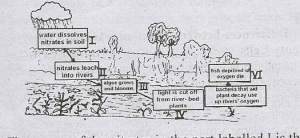
- A. denitrification
- B. conservation
- C. eutrophication
- D. global warming
The structure of the cell membrane is a
- A. double layer and a double protein layer
- B. middle bi-layer of protein with a lipid layer on either surface
- C. middle bi-layer of lipid with a protein layer on either surface
- D. protein layer with two inner lipid layers
What type of relationship exists in the large intestine of the sheep, between bacteria and the sheep?
- A. Symbiosis
- B. Commensalism
- C. Predation
- D. Parasitism
The bone of the neck on which the skull rests is known as the
- A. odontoid process
- B. axis
- C. atlas
- D. occipital condyle
Which of the following sets is made up of decomposers?
- A. Rhizophus, earthworm and protozoa
- B. Mushroom, rhizophus and bacteria
- C. Bacteria, earthworm and nematodes
- D. earthworm, sedges and platyhelminthes
Your neighbor has a flower garden in which there are red flowers and white flowers. These flowers are diploid organisms, and flower color is an autosomal trait. The gene for red flowers (R) is dominant, while the gene for white flowers (r) is recessive. Which of the following could be the genotype of a red flower?
- A. rr only
- B. Rr only
- C. Rr or rr only
- D. RR or Rr only
The anaerobic fermentation of a glucose molecule yields
- A. 38 ATP molecules
- B. 2 ATP molecules and alcohol
- C. pyruvic acid and alcohol
- D. water and carbon (IV) oxide
Which of the following statements about human blood groups is not true?
- A. A is dominant over B
- B. O is recessive
- C. B is dominant over O
- D. A and B are co-dominant
Which of the following groups of organisms do not have members that can be called autotrophs?
- A. Protists
- B. Mosses
- C. Chlorophyta
- D. Fungi
Fertilization in humans usually takes place in the
- A. lower part of the uterus
- B. upper part of the uterus
- C. lower part of the oviduct
- D. upper part of the oviduct