

Biology Past Questions And Answers
Soil with the finest texture is?
- A. silt
- B. clay
- C. sand
- D. gravel
Which of the following are the final products of aerobic respiration?
- A) water, carbon dioxide and energy
- B) pyruvic acid, carbon dioxide and water
- C) glucose, energy and urea
- D) energy and carbon dioxide
Thunderstorm can be beneficial to plants because it
- A. kills the pest that attacks crops
- B. destroys some of the major crops
- C. adds nitrates to the soil
- D. adds lime to the soil
Which of following is NOT involved in the transport of substance in the body?
- A. Lymph
- B. Plasma
- C. Leucocytes
- D. Erythrocytes
The diagram below are illustrations of two different cells involved in biological processing in mammals. Study them and answer this question.
If the number of chromosomes in the skin cells of mammals is 46, how many chromosomes would be found in P and Q respectively?
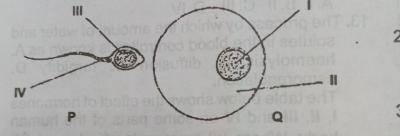
- A. 23 and 23
- B. 23 and 46
- C. 46 and 23
- D. 46 and 46.
Natural selection favors the gene alleles of organisms that are more fit than other organisms in the same population. Which of the following is the best example of biological fitness?
- A. An individual that has more grandchildren than any other member of its population.
- B. An individual that grows to a larger size than any other member of its population.
- C. An individual that has a longer lifespan than any other member of its population.
- D. An individual that consumes more food than any other member of its population.
The group of Arthropods that has no antennae is the
- A. Crustacea
- B. Chilpoda
- C. Arachnida
- D. Diplopoda
Which of the following insects undergoes incomplete metamorphosis?
- A. Mosquito
- B. Termite
- C. Housefly
- D. Moth
A wide pith with a ring of conducting tissue is characteristic of the root of
- A. sunflower
- B. maize
- C. bean
- D. okra
The nitrifying bacteria, Nitrosomonas, convert ammonia to
- A. nitirites
- B. nitric acid
- C. niitrates
- D. nitrous oxide