

Biology Past Questions And Answers
One common characteristic of fungi, algae, mosses and ferns is that they
- A. show alternation of generations
- B. reproduce sexually by conjugation
- C. produce spores that are dispersed
- D. possess chlorophyll in their tissues
The most sensitive part of the retina is called
- A) blind spot
- B) conjunctiva
- C) fovea centralis
- D) chorold coat
(a) Define the following in
(i) elimination
(ii) excretion
(iii) secretion.
(b) Describe the digestion of boiled fish in the gut of humans
(c) Make a diagram 8cm - 10am long of a longitudinal section of a villus and label fully.
View Discussion (0)WAEC 2014 THEORYOne of the functions of xylem
- A) strengthening the stem
- B) manufacturing food
- C) conducting manufactured food
- D) none of the above
The use of moist skin for respiration in amphibians is known as
- A. cellular respiration
- B. cutaneous respiration
- C. buccal respiration
- D. pulmonary respiration
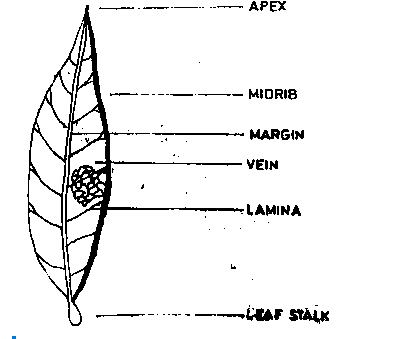
The diagram below is an illustration of a mango leaf drawn by a student in a Biology test. The student failed the test. Study it and answer the question.
which features of the diagram would have earned the student more marks if shown
- A. colour and size
- B. spelling of label and length of midrib
- C. habitat and agricultural qualities of leaf
- D. title and margin
The source of energy required by plants during food production is
- A. Photosynthesis
- B. Chlorophyll
- C. Sunlight
- D. Microorganisms
In a tropical rain forest, non-epiphytic ferns and allies occur as
- A. middle storey species
- B. upper storey species
- C. shade-loving species
- D. emergent species
Which of the following processes takes place when a plant cell is put in a hypotonic solution?
- A. Water moves into the cell and the cell bursts
- B. Water leaves the cell and the cell becomes flabby
- C. Water moves into the cell and the cell becomes turgid
- D. The cell becomes plasmolysed
(a)(i) Name two types of germination of seeds giving one example of each type.
(ii) Describe a simple experiment to demonstrate that oxygen, water and warmth are necessary for germination of seeds.
(b) State two distinguishing features each of
(i) epiphytes
(ii) parasites
(c) Give two examples o parasitic plants.
View Discussion (0)WAEC 2010 THEORY