

Biology Past Questions And Answers
The eggs of birds contains relatively larger quantities of yolk than those of amphibians and reptiles because
- A. birds are generally bigger in size
- B. embryonic development is longer in birds
- C. those of birds are fertilized internally
- D. birds lay shelled eggs
A child that can receive blood donation from anybody belongs to the blood group
- A. O
- B. A
- C. B
- D. AB
Which of the following organs regulates the levels of water, salts , hydrogen ions and urea in the mammalian blood?
- A. Liver
- B. Kidney
- C. Bladder
- D. Colon
The process of shedding the exoskeleton of an arthropod is known as
- A. metamorphosis
- B. instar formation
- C. ecdysis
- D. tagmosis
Which of the following changes is most likely to increase the evolutionary fitness of an organism?
- A. A mutation that enables it to live in a new environment
- B. A mutation that enables it to be bigger than its peers
- C. A mutation that enables it to be stronger than its peers
- D. A mutation that enables it to produce a larger number of viable offspring than its peers
The initial volume of water poured into a bag of dry soil was 50ml and the amount that drained through was 35mI. The percentage water content of the fully soaked soil is therefore?
- A. 46.7
- B. 25.0
- C. 20.0
- D. 30.0
The short thick beak in birds is an adaptation for
- A. crushing seeds
- B. sucking nectar
- C. tearing flash
- D. straining mud
Which of the following is not a function of insulin?
- A. Accelerates the rate at which glucose is converted to glycogen
- B. Promotes the uptake of glucose by tissues
- C. Regulates the amount of glucose in the blood
- D. Stimulates muscles to oxidize glucose.
In the diagram of the human sperm above, the function of the part labelled II is to
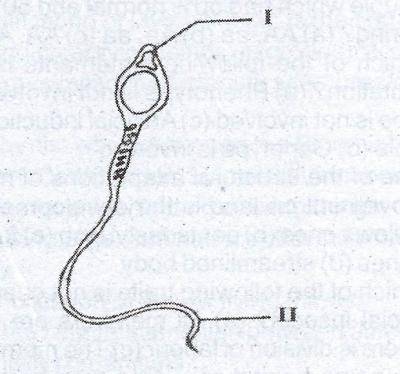
- A. fuse the ovum during fertilization
- B. generate the energy for the sperm to swim to the fallopian tube
- C. help the sperm to swim forward
- D. dissolve the membrane of the egg during fertilization
Which of the following pairs of organisms are photosynthetic?
- A. Amoeba and paramecium
- B. Euglena and chlamydomonas
- C. Volvox and Rhizopus
- D. Nostoc and plasmodium