

Biology Past Questions And Answers
The exchange of gases between the environment and the respiratory organs of vertebrates is referred to as
- A. inhalation
- B. respiration
- C. expiration
- D. breathing
A group of closely related organisms capable of interbreeding to produce fertile offspring are known as members of a
- A. kingdom
- B. class
- C. family
- D. species
Which of the following is a primary source of pollution in aquatic ecosystems?
- A. Soil erosion
- B. Industrial discharge
- C. Air pollution
- D. Deforestation
Example of genetic diseases include any of the following except _______
- A) diabetes
- B) cystic fibrosis
- C) hepatitis
- D) epilepsy
The falling off of leaves of deciduous trees is helpful to the plant because it
- A. reduces the rate of transpiration
- B. enables the plant to conveniently eliminate its excretory products
- C. enables the plant to bear more fruits
- D. ensures that the limited mineral salts get to only growing regions
Which of the following organisms is not a social insect?
- A. Termites
- B. Ants
- C. Grasshoppers
- D. Bees
The diagram below are illustrations of an experimental set-up to demonstrate a type of tropic response in plants. The type of response demonstrated is
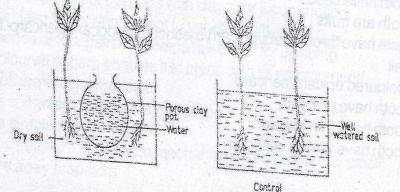
- A. phototropism
- B. geotropism
- C. hydrotropism
- D. thigmotropism
In which of these are flagella and cilia found?
- A) flatworms
- B) protozoa
- C) coelenterates
- D) annelids
The part of the ear which contains nerve cells sensitive to sound vibrations is the
- A. cochlea
- B. ampulla
- C. tympanum
- D. malleus
The diagram below is an illustration of some structures used for gaseous exchange in humans. Study it and answer the question
The parts labeled 1, II, III, and IV respectively are
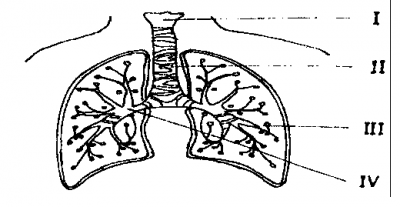
- A. larynx, bronchus, bronchiole and trachea.
- B. bronchus, bronchiole, trachea and larynx.
- C. bronchiole, trachea, bronchus and larynx.
- D. larynx, trachea, bronchiole, and bronchus.