

Biology Past Questions And Answers
A sex-linked character cannot be passed on directly from
- A. father to son
- B. mother to daughter
- C. mother to son
- D. father to daughter
I. Stomata → Spirogyra II. Alveoli → Earthworm III. Malpighian tubule → Mammal IV. Contractile vacuole → Protozoa. Which of the above structures is correctly matched with the organisms in which it is found?
- A. lll
- B. ll
- C. l
- D. IV
The intensity of competition among animals in a given area will increase with
- A. an increase in the frequency of disease outbreaks
- B. an increase in population size
- C. a decrease in immigration rate
- D. an increase in the emigration rate
(a) What is a sensory cell?
(b) State one function each for the following parts of mammalian eye: (i) lens; (ii) vitreous humour; (iii) optic nerve.
(c) (i) List four structures which protect the eye from injury.
(ii)Explain briefly how each of these structures performs its function.
(d) Explain why a person in a dark room is dazzled for some seconds when he is suddenly exposed to bright sunlight.
View Discussion (0)WAEC 1995 THEORYA band of connective tissue linking two bones in a joint is known as
- A. tendon
- B. cartillage
- C. synovial membrane
- D. ligament
The animals that move by means of flagella include
- A. Chlamydomonas and Euglena
- B. Planeria and Amoeba
- C. Amoeba and Hydra
- D. Paramecium and Planeria
Which of the following conditions is NOT necessary for photosynthesis to take place?
- A. ChlorophyII
- B. Light
- C. Carbon(II)oxide
- D. Carbon(IV)oxide
5.(a) State three differences between the alimentary canals of earthworm and cockroach.
(i) State three similarities between the alimentary canals of earthworm and cockroach.
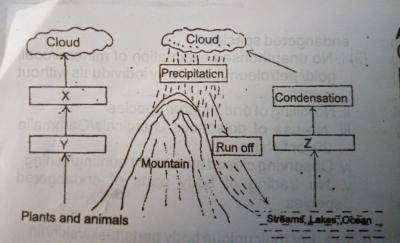
(b) The diagram below is an illustration of a biological cycle.
Study it and answer questions 5(b)i) to 5(b)(iii)
[i]Name the biological cycle (i) Explain briefly three roles played by plants and animals in the cycle (ii) Name the process that occur in X, Y and Z.
c. complete the table below.
| organs associated with excretion in human | three diseases that affect the organ |
(d)i) What is decay of organic matter
(i) Name two groups of organisms that cause decay of organic matter.
(i) State one other factor that causes decay.
(iv) Name the biological cycle that involves decay.
(e) Explain briefly the mode of nutrition in carnivorous plants.
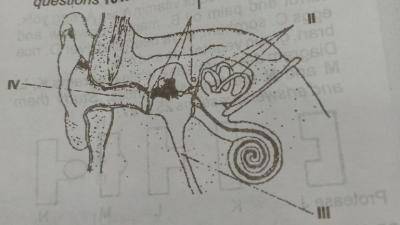
The diagram below is an illustration of some parts of a mammalian ear. Study it and answer this question.
The parts labelled I are the?
- A. semi circular canals
- B. ossicles
- C. cochlea
- D. external auditory meatus
Which of the following is the direct consequence of transferring energy from one trophic level to another?
- A. An increase in biomass
- B. A decrease in the efficiency
- C. An increase in the total numbers of resulting individuals
- D. A decrease in the resulting biomass