

Biology Past Questions And Answers
A vestigial structure in humans is
- A. earlobe
- B. gallbladder
- C. tailbone
- D. villus
Plants which can survive in places where the water supply is limited are
- A) bryophates
- B) mesophytes
- C) xerophytes
- D) hydrophytes
The process of transforming the chemical energy of cellular fuels into the high energy bonds of ATP in plants is
- A. autotrophism
- B. photosysnthesis
- C. photolysis
- D. respiration
Disulfide bonds can add stability to the structure of a protein. The formation of disulfide bonds occurs in the formation of what level of protein structure?
- A. Quaternary
- B. During translation
- C. Tertiary
- D. Primary
A seedling grown in the dark is likely to be
- A. etiolated
- B. dormant
- C. sturdy
- A. etiolated D. stunted
The following organisms have structures for movement except
- A. Amoeba
- B. Spirogyra
- C. Volvox
- D. Paramecium
Paternity disputes could be resolved accurately through
- A. finger printing
- B. tongue rolling
- C. DNA test
- D. blood group
Which of the following is associated with the dark stage of photosynthesis?
- A. Assimilation of Carbon(IV)oxide
- B. Photophosphorylation
- C. Photolysis
- D. Excitation of chlorophyll
The diagram below is an illustration of a cell in which photosynthesis takes place. Study it and answer the question
In which of the labeled parts would molecules of water and carbon (IV) oxide combine to form sugar?
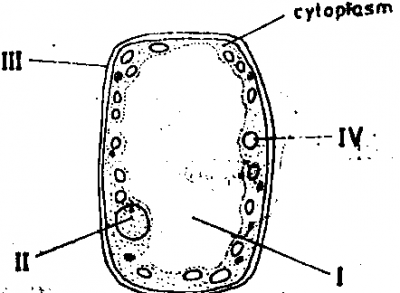
- A. I
- B. III
- C. II
- D. IV
_________ is used for photosynthesis in Euglena sp.
- A) Reservoir
- B) Nucleus
- C) Chloroplast
- D) Paramylon granule