

Biology Past Questions And Answers
The lack of special supportive structures in bryophytes restricts them to one of the following types of growth.
- A) lateral growth
- B) upward growth
- C) downward growth
- D) aerial growth
The ability of living organism to detect and respond to changes in the environment is referred to as
- A. locomotion
- B. irritability
- C. growth
- D. taxis
The sequence of the one-way gaseous exchange mechanism in a fish is
- A. gills ⇢ operculum ⇢ mouth
- B. mouth ⇢ gills ⇢ operculum
- C. mouth ⇢ operculum ⇢ gills
- D. operculum ⇢ mouth ⇢ gills
The factors which determine the type of vegetation a particular habitat will support are related to the following except
- A. nature of the soil particles
- B. amount of rainfall
- C. mineral content of the soil
- D. depth of the water-table
The mutualism type of relationship is different from a parasitic relationship because in mutualism
- A. both organisms involved benefit
- B. none of the organisms benefits or harm each other
- C. both organisms harm each other
- D. only one of the organisms is harmed
A sample of wet garden soil of known weigh was heated to constant weight. The loss of weight is due to loss of
- A. water
- B. organic matter
- C. water and organic matter
- D. water and inorganic matter
What is the difference between viviparous and oviparous animals?
- A. Possession of yolked eggs
- B. Laying of unfertilized eggs
- C. Possession of yolkless eggs
- D. Laying and brooding of eggs
The diagram below is an illustration of the growth of a plant in a water culture. After a few days, the solution turned green and the plant died. Use this to answer this question.
The death of the plant was likely caused by?
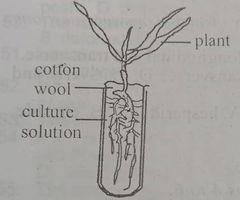
- A. excess supply of nutrients to the plant
- B. inadequate supply of water to the plant
- C. algal growth in the solution that used up the nutrients
- D. inability of the plant to make food due to lack of sunlight
The part of a domestic fowl responsible for preventing heat loss is the
- A. filoplume
- B. contour feather
- C. down feather
- D. quill
This tissue is made up of tracheids, vessels, fibres and parenchyma. What is it?
- A) Phloem
- B) sclerenchyma
- C) xylem
- D) ground tissue