

Waec 2017 Physics Past Questions And Answers
A plane is inclined at an angle \(\theta\) to the horizontal. Its velocity ratio is
- A. \(sin\theta\)
- B. \(tan\theta\)
- C. \(\frac{1}{sin\theta}\)
- D. \(\frac{1}{tan\theta}\)
Consider the wave equation: y=10sin(x?50t), What does the number 10 represent?
- A. Acceleration
- B. Speed
- C. Amplitude
- D. Wavelength
The diagram below illustrates a beaker of water being heated. It is observed that as the bubbles rise they get bigger in size.The reason for this observation is
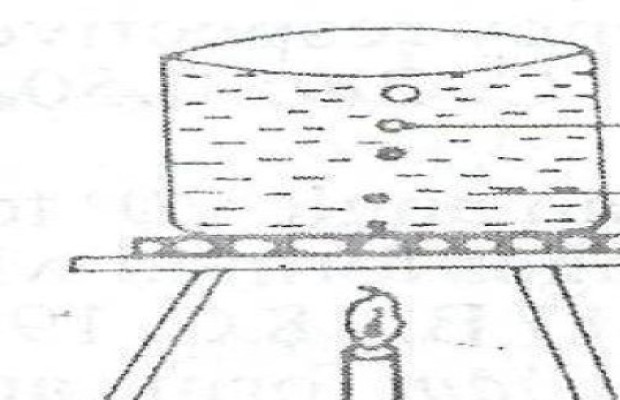
- A. water pressure on the bubbles decreases
- B. density of water increases with rise in temperature
- C. volume of water increases with rise in temperature
- D. atmospheric pressure on the bubbles decreases
A vapour whose molecules are in dynamic equilibrium with those of its own liquid is said to be
- A. unsaturated
- B. gaseous
- C. saturated
- D. diffused
List three advantages of fluorescent tubes over filament bulbs.
View Discussion (0)WAEC 2017 THEORYWhich of the following devices converts light energy to electrical energy?
- A. Bulb
- B. Television
- C. Solar cell
- D. Light emitting diode (LED)
A particle is projected horizontally at 15ms\(^{-1}\) from a height of 20m. Calculate the horizontal distance covered by the particle just before hitting the ground. [g= 10ms\(^{-2}\)]
View Discussion (0)WAEC 2017 THEORY.jpg)
Thermal energy added or removed from a substance that changes the state of the substance is called
- A. latent heat
- B. heat of reaction
- C. calorimetry
- D. specific heat
The angle at which a projectile must be fired to cover maximum range is
- A. 30°
- B. 45°
- C. 60°
- D. 90°
The inverse of the time required for a wave to complete one full cycle is called
- A. wavelength
- B. period
- C. frequency
- D. amplitude