

Jamb 1993 Physics Past Questions And Answers
A parallel plate capacitor of area 10cm2 in vacuum has a capacitance of 10-2\(\mu\)F. What is the distance between the plates?(e = 9 x 10-12fm)
- A. 9 x 10-13m
- B. 9 x 10⁻⁷m
- C. 9 x 10⁻³m
- D. 9 x 10⁷m
The diagram below shows a velocity time graph representing the motion of a car. Find the total distance covered during the acceleration and retardation of the motion
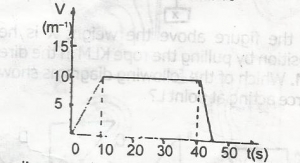
- A. 75m
- B. 150m
- C. 300m
- D. 375m
A 40-W instrument has a resistance of 90Ω. On what voltage should it be operated normally?
- A. 60V
- B. 150V
- C. 225V
- D. 3600V
Natural radioactivity is the random spontaneous disintegration of the nuclei of heavy isotopes of certain elements with the emission of
- A. \(\alpha\), X-rays, and \( \beta\)
- B. \(\alpha\), \(\beta\) and \(\gamma\)-rays
- C. X, \(\alpha\), \(\gamma\)-ray
- D. \(\alpha\), \( \beta\) and X-rays
Which of the following correctly describes the energy changes in the generation of light by a hydroelectric power station?
- A. Electrical ? mechanical ? potential
- B. potential ?mechanical ?electrical ? light
- C. mechanical ? sound ? electrical ? light
- D. kinetic ? mechanical ? electrical ?light
Which of the following devices may be used to step up the voltage in a d.c. circuit?
- A. a step-up transformer
- B. a d.c. generator
- C. a wattmeter
- D. an induction coil
The external and internal diameter of a tube are measured as (32 ± 2)mm and (21 ± 1)mm respectively. Determine the percentage error in the thickness of the tube.
- A. 27%
- B. 14%
- C. 9%
- D. 3%
Determine the inductive reactance when a 30.0mH inductor with a negligible resistance is connected to a 1.3 x 10³Hz oscillator.
- A. 39.0Ω
- B. 122.5Ω
- C. 245.0Ω
- D. 39000.0Ω
Which of the following correctly explains why soft iron is proffered to steel in electromagnets? i. soft iron is more readily magnetized than steel. ii. soft iron is more readily demagnetized than steel. iii. soft iron retains magnetism more than steel.
- A. i only
- B. ii and iii only
- C. i and ii only
- D. i, ii, and iii.
When a brick is taken from the earth's surface to the moon, its mass
- A. remains constant
- B. reduces
- C. increases
- D. becomes zero