

Physics Past Questions And Answers
An ebonite rod rubbed with fur attracts a glass rod rubbed with silk because
- A. ebonite has a negative charge while glass has a positive charge
- B. ebonite has a positive charge while glass has a negative charge
- C. both have negative charges
- D. both have positive charges
The mass attached to a string is moving in a circular path. If the speed is doubled, the tension in the string will be
- A. doubled
- B. halved
- C. four times as great
- D. one-fourth as much
The absolute zero temperature is defined as the temperature at which
- A. thermal motion ceases
- B. the temperature of a gas is 273°C
- C. ice melts
- D. the volume of a real gas is maximum
In the fig below if the atmospheric pressure is 760mm, the pressure of the chamber G is
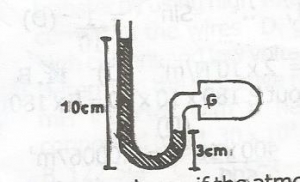
- A. 660mm
- B. 690mm
- C. 830mm
- D. 860mm
(a) Using a suitable diagram, explain how the following can be obtained from a velocity-time graph (i) acceleration; (ii) retardation; (iii) total distance covered.
(b) Show that the displacement of a body moving with uniform acceleration a is given by \(s = ut + \frac{1}{2} at^{2}\) where u is the velocity of the body at time t = 0.
(c) A particle moving in a straight line with uniform deceleration has a velocity of 40ms\(^{-1}\) at a point P, 20ms\(^{-1}\) at a point Q and comes to rest at a point R where QR = 50m. Calculate the: (i) distance PQ; (ii) time taken to cover PQ; (iii) time taken to cover PR.
View Discussion (0)WAEC 1990 THEORY.jpg)
A particle in circular motion performs 30 oscillation in 6 seconds. Its angular velocity is
- A. 5 rad/s
- B. 6 rad/s
- C. 5π rad/s
- D. 10π rad /s
(a) (i) Define uniform acceleration.
(ii) Write an equation that relates linear velocity, angular velocity and radius
of path in circular motion.
(b) Two forces 30 N and 40 N act at right angles to each other. Determine by scale drawing, the magnitude and direction of the resultant force,.using a scale of 1 cm to 5 N.
(c) Explain why ships are usually refilled with sand and water after they have been emptied of their cargo.
(d) A crate of drinks of mass 20 kg is placed on a plane inclined at 30° to the horizontal. If the crate slides down with a constant speed, calculate the:
(i) co-efficient of kinetic friction;
(ii) magnitude of the frictional force acting on the crate. [ g = 10 ms\(^{-2}\)]
View Discussion (0)WAEC 2015 THEORY.jpg)
Which of these statements are TRUE of pressure in liquids? i. pressure acts equally in all direction. ii. pressure decreases with depth. iii. pressure at the same level of a liquid is the same. iv pressure is dependent on the cross-sectional area of the barometer tube
- A. i, iii only
- B. i, ii, iii only
- C. i, iii, and iv only
- D. i, ii, iii and iv
Masses,m1 and m2 at the 20-cm and 65-cm marks respectively of a uniform metre rule freely suspended at its centre of gravity. If the metre rule balances horizontally, determine the ratio m2 : m1
- A. 2 : 1
- B. 3 : 3
- C. 2 : 3
- D. 1 : 2
What volume of alcohol will have same mass as 4.2m-3 of petrol? Density of alcohol = 8.4 x 10² kgm-3, density of petrol =7.2x10² kgm-3
- A. 0.8m3
- B. 1.4m3
- C. 3.6m3
- D. 49.m3