

Physics Past Questions And Answers
A circuit has a resistance of 200Ω. The resistance of the circuit can be reduced to 120Ω when
- A. A 300Ω resistor is connected to it in parallel
- B. An 80Ω resistor is conneceted to it in series
- C. A 150Ω resistor is connected to it in parallel
- D. A 240Ω resistor is connected to it in series
The p-n junction diodes can act as rectifiers because they
- A. conduct current when forward-biased
- B. conduct current when reverse-biased
- C. block current when forward-biased
- D. conduct current in both directions
The diagram below illustrates a simple barometer. Which distance measures the atmospheric pressure?
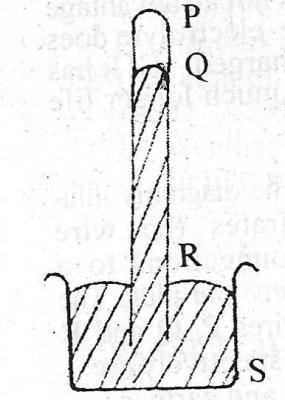
- A. PQ
- B. QR
- C. RS
- D. QS
The inductive reactance in a circuit of frequency 100Hz is 1ohms. Calculate the inductance of the inductor[π = 3.14]
- A. 2.00 x 10\(_{-3}\)H
- B. 1.59 x 10\(_{-3}\)H
- C. 1.09 x 10\(_{-3}\)H
- D. 6.28x 10\(_{-3}\)H
A student wishes to measure the potential difference across a resistor,R. She has a galvanometer,G and some connecting wires.
What else does she need?
- A. high value resistor connected in parallel with G
- B. . low value resistor connected in parallel with G low value
- C. resistor connected in series with G
- D. high value resistor connected in series with G.
A piece of radioactive material contains 1000 atmos. If its half -life is 20seconds, the time taken for 125 atoms to remain is
- A. 20 seconds
- B. 40 seconds
- C. 80 seconds
- D. 60 seconds
An object is placed 20cm from a concave mirror of focal length 15cm. Calculate the linear magnification of the image formed
- A. 0.5
- B. 1.5
- C. 2.0
- D. 3.0
A block of wood of density 0.6 gcm\(^{-3}\), weighing 3.06N in air, floats freely in a liquid of density 0.9 gcm\(^{-3}\). Calculate volume of the portion immersed (g = 10ms\(^{-2}\))
- A. 510cm3
- B. 340cm3
- C. 254cm3
- D. 170cm3
The diagram below shows two vectors at right angles to each other. The value of the resultant vector is
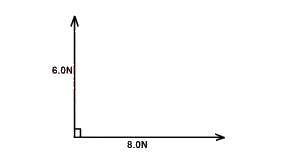
- A) 14.0 N
- B) 10.0 N
- C) 12.0 N
- D) 13.0 N
The diagram below shows two wave forms P and Q at a particular instant in time. the two waves will interface
- A. destructively to produce a wave of larger amplitude
- B. destructively to produce a wave of smaller amplitude
- C. constructively to produce a wave of larger amplitude
- D. constructively to produce a wave of smaller amplitude