

Physics Past Questions And Answers
The voltage and current in the primary of a transformer are 200V and 2A respectively. lf the transformer is used to light ten 12 V, 30 W bulbs, calculate its efficiency.
- A. 100%
- B. 90%
- C. 75%
- D. 50%
A body of mass 2kg moving vertically upwards has its velocity increased uniformly from 10ms-1 to 40ms-1 in 4s. Neglecting air resistance, calculate the upward vertical force acting on the body.[g = 10 ms-1]
- A. 15N
- B. 20N
- C. 35N
- D. 45N
As the plates of a charged variable capacitor are moved closer together, the potential difference between them
- A. increased
- B. decrease
- C. remains the same
- D. is doubled
A transverse wave and a longitudinal wave travelling in the same direction in a medium differ essentially in their
- A. frequency
- B. amplitude
- C. direction of vibration of the particles of the medium
- D. period of vibration of the particles of the medium
A moving-coil meter with an internal resistance of 100Ω has a full-scale deflection when a current of 10m2 flows through it. What value of resistance would convert it to read 10V at full- scale deflection?
- A. 20
- B. 100
- C. 600
- D. 900
In an experiment in which molten naphthalene is allowed to cool, the cooling curve i n the figure was obtained. The temperature 80C is known as the
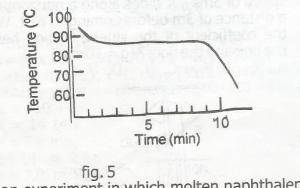
- A. cooling temperature
- B. boiling point
- C. melting point
- D. vaporization point
The basic difference between a transverse wave and a longitudinal wave travelling in the same direction in a medium is in the
- A. amplitude of the wave
- B. wavelength of the wave
- C. direction of vibration of the particles of the medium
- D. period of vibration of the particle of the medium
Which of the following source of energy is renewable?
- A. sun
- B. petroleum
- C. coal
- D. uranium
(a)(i) Define the term linear momentum.
(ii) State the law of conservation of linear momentum.
(b) A ball P of mass 0.25 kg, loses one-third of its velocity when it makes a head on collision with an identical ball Q at rest. After the collision, Q moves off with a speed of 2ms\(^{-1}\) in the original direction of P. Calculate the initial velocity of R
(c)(i) State Newton's second law of motion.
(ii) Show that F = ma where F is the magnitude of the force acting on a body of mass m to give it an acceleration of magnitude a.
(iii) The engine of a vehicle moves it forward with a force of 9600 N against a resistive force of 2200 N. If the mass of the vehicle is 3400 kg, calculate the acceleration produced.
View Discussion (0)WAEC 2000 THEORYWhich of the following actions will not cause an increase in the frequency of a vibrating string?
- A. increasing the tension of the string
- B. decrease the mass per unit lengthof the string
- C. decrease the length of the string
- D. increasing the cross sectional area of the string