

Physics Past Questions And Answers
Ether produces a cooling effect when it is poured on the hand because it has
- A. low conductivity
- B. high conductivity
- C. high latent heat of vaporization
- D. low latent heat of vaporization
Which of the following is NOT a Fundamental S.I unit?
- A. Metre
- B. Ampere
- C. Newton
- D. Second
(a) Explain the term electrolyte and give two examples.
(b) State the relationship between the mass of a substance liberated during electrolysis and the charge passed.
View Discussion (0)WAEC 2003 THEORYWhich of the following properties of a long steel bar would alter if the bar were melted, recast into a cube and allowed to cool to its original temperature?
- A. sensity
- B. volume
- C. specific heat capacity
- D. electrical resistance
The speed of sound in air is 330ms-1. How far from the centre of a storm is an observer who hears a thunder clap 2s after the lightning flash? (Neglect the time taken by light to travel to the observer)
- A. 1320m
- B. 660m
- C. 600m
- D. 330m
The production of pure spectrum could easily be achieved using a?
- A) glass prism with a pin
- B) triangular prism with two convex lens
- C) traingular prism only
- D) triangular prism with two concave lenses
A ball is moving at 18ms-1 in a direction inclined at 60o to the horizontal. The horizontal component to its velocity is
- A.9√3ms-1
- B.6√3ms-1
- C.8√3ms-1
- D.9ms-1
Four cells each of e.m.f 1.5V and internal resistance of 4Ω are connected in parallel. What is the effective e.m.f. and internal resistance of the combination?
- A. 6.0V, 16Ω
- B. 6.0V, 1Ω
- C. 1.5V, 4Ω
- D. 1.5V, 1Ω
What is the potential difference between X and Y in the diagram below if the battery is of negligible internal resistance
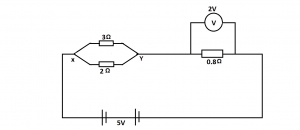
- A. 12.5V
- B. 5.8V
- C. 5.0V
- D. 3.0V
(a) Explain the term net force.
(b) Define the principle of conservation of linear momentum and state one example of it.
(c) A ball of mass 200 g released from a height of 2.0 m hits a horizontal floor and rebounds to a height of 1.8 in. Calculate the impulse received by the floor. (g = 10 ms\(^{-2}\)).
(d) A body of mass 20 g performs a simple harmonic motion at a frequency of 5 Hz. At a distance of 10 cm from the mean position, its velocity is 200 cms\(^{-1}\). Calculate its:
(i) maximum displacement from the mean position;
(ii) maximum velocity;
(iii) maximum potential energy. (g = 10 ms\(^{-2}\) \(\pi\) = 3.14)
View Discussion (0)WAEC 2016 THEORY