

Physics Past Questions And Answers
The relationship between the coefficient of linear expansion \(\alpha\) and volumetric expansion (\(\gamma\)) is------
- A. \(\gamma\) = \(\alpha ^{-3}\)
- B. \(\gamma\) = \(\alpha\)
- C. 3\(\alpha\)
- D. \(\gamma\) = \(\alpha ^{3}\)
Two metals P and Q are heated through the same temperature difference. If the ratio of the linear expansivities of P to Q is 2:3 and the ratio of their Length is 3: 4 respectively, the ratio of the increase in lengths of P to Q is
- A) 1:2
- B) 2:1
- C) 8:9
- D) 9:8
Which of the following statement(s) is/are correct about a fixed mass of gas compressed in an inexpansible container;
I. The average speed of the molecules increases
II. The temperature of the gas increases
III. The molecules hit the walls of the container more often than before the compression
- A. I only
- B. I and II only
- C. I, II, and III only
- D. I and III
Which of the following can be described as high tension transmission?
- A. High resistance and low voltage
- B. Low current and high voltage
- C. High current and low voltage
- D. High current and low resistance
In a hydraulic press, a force of 40N is applied to the smaller priston of area 10cm2. If the area of the larger piston is 200cm2, calculate the force obtained
- A. 800N
- B. 500N
- C. 80N`
- D. 50N
A machine of efficiency 80% is used to lift a box. If the effort applied by the machine is twice the weight of the box. Calculate the velocity ratio of the machine
- A. 0.50
- B. 0.63
- C. 0.80
- D. 1.60
The wire of a platinum resistance thermometer has d resistance of 3.5\(\Omega\) at 0 °C and 10.52\(\Omega\) at 100°C. Calculate the temperature of the wire when its resistance is 7.5\(\Omega\).
- A.78 \(^o\)C
- B.25 \(^o\)C
- C.30\(^o\)C
- D.57 \(^o\)C
Consider the wave equation y = 5mm sin [1cm-1x - 60s-1t]. The wave number is?
- A. 0.1 cm-1
- B. 10cm-1
- C. 1.0cm-1
- D. 2cm-1
A hygrometer is an instrument used to measure
- A. Dew point
- B. Temperature
- C. Relative density
- D. Relative humidity
The diagram given illustrates two charged particles W and X. The charges on W and x are respectively
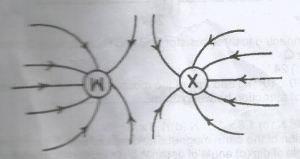
- A. negative; negative
- B. negative; positive
- C. positive; positive
- D. positive; negative