

Physics Past Questions And Answers
Which of the following is used a nuclear reactor to slow down fast moving neutrons?
- A. Carbondioxide gas
- B. Liquid sodium metal
- C. Concrete shield
- D. Graphite rods
The cubic expansivity of mercury is 1.8 x 10⁻⁴K-1 and the linear expansivity of glass 8.0 x 10⁻⁶K-1, calculate the apparent expansivity of mercury in a glass container
- A. 1.00 x 10⁻⁴K-1
- B. 1.56 x 10⁻⁴K-1
- C. 1.72 x 10⁻⁴K-1
- D. 2.04 x 10⁻⁴K-1
The velocities of light in air and glass are 3.0 x 10⁸ms-1 and 2.0 x 10⁸ms-1 respectively. If the angle of refraction is 30°, the sine of the angle of incidence is
- A. 0.33
- B. 0.50
- C. 0.67
- D. 0.75
Find the effective resistance in the diagram below
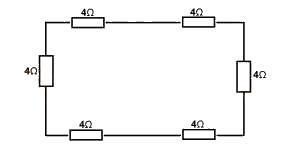
- A) 6 Ω
- B) 12 Ω
- C) 18 Ω
- D) 24 Ω
In the below circuit, The fuse wire melts when
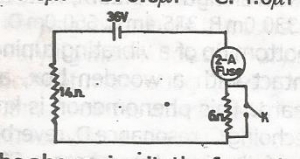
- A. K is Opened
- B. K is closed
- C. the 14 ohm resistor is doubled with k closed
- D. the 6 ohm resistor is doubled with k closed
An object of mass 2kg moving with a velocity 3ms-1 collides head-on with another object of mass 1kg moving in the opposite direction with a velocity of 4ms-1. If the objects stick together after collision, calculate their common speed.
- A. 0.60ms-1
- B. 0.67ms-1
- C. 2.00ms-1
- D. 3.33-1
Calculate the magnitude of the force required to just move a 20kg object along a horizontal surface if the coefficient of friction is 0.2. [g = 10ms-2]
- A. 400.0N
- B. 40.0N
- C. 4.0N
- D. 0.4N
When an atom loses or gains a charge, it becomes
- A. an electron
- B. an ion
- C. a neutron
- D. a proton
A body timed 20 oscillations of a certain pendulum three times and obtained 44.3s, 45.5s and 45.7s respectively. Calculate the mean period of oscillation of the pendulum
- A. 0.13s
- B. 2.22s
- C. 2.26s
- D. 44.30s
A parachute attains a terminal velocity when
- A. its density is equal to the density of air
- B. the viscous force of the air and the upthrust completely counteract its weight
- C. it expands as a result of reduced external pressure
- D. the viscous force of the air is equal to the sum of the weight and upthrust