

Physics Past Questions And Answers
The time rate of loss of heat by a body is proportional to the
- A. difference in temprature between the body and its surroundings
- B. temperature of its surroundings
- C. ratio of the temperature of the body to that of its surroundings
- D. temperature of the body
The inverse of the time required for a wave to complete one full cycle is called
- A. wavelength
- B. period
- C. frequency
- D. amplitude
The gravitational pull on the moon is 1/6 that of the earth. If a body weighs 6.0 N on the moon, what will be the weight on the earth?
- A. 6.0 N
- B. 5.0 N
- C. 12.0 N
- D. 36.0 N
power is defined as the
- A. capacity to exert a force
- B. product of force and time
- C. product of force and distance
- D. energy expended per unit time
A beam PQ pivoted at P carries a load of 80N as shown above. Calculate the effort E, required to keep it horizontal. [neglect the weight of the beam]
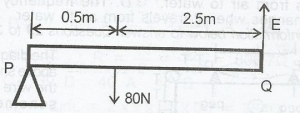
- A. 32.0N
- B. 26.7N
- C. 16.0N
- D. 13.3N
Which of the following devices converts light energy to electrical energy?
- A. Bulb
- B. Television
- C. Solar cell
- D. Light emitting diode (LED)
What is the speed of a body vibrating at 50 cyclic per second
- A. 100 πrads−1
- B. 200 πrads−1
- C. 50 πrads−1
- D. 400 πrads−1
A moving object is said to have a uniform acceleration if its
- A. displacement decreases at a constant rate
- B. speed is directly proportional with time
- C. velocity increases by equal amount in equal time intervals
- D. velocity varies inversely with time
A satellite in circular motion around the earth does not have
- A. a gravitational force acting on it
- B. a uniform velocity
- C. an acceleration
- D. a centripetal force acting on it
(a) State two conditions under which photo-electrons can be emitted from the surface of a metal.
(b) List two particle characteristics of electromagnetic waves.
View Discussion (0)WAEC 2014 THEORY