

Physics Past Questions And Answers
(a) Write the de Broglie equation.
(b) Explain the significance of the equation.
View Discussion (0)WAEC 2015 THEORYThe silver coating on the inside of a vacuum flask reduces heat loss by
- A. conduction
- B. radiation
- C. condensation
- D. convention
A 35 kΩ is connected in series with a resistance of 40 kΩ. What resistance R must be connected in parallel with the combination so that the equivalent resistance is equal to 25 kΩ?
- A. 40 kΩ
- B. 37.5 kΩ
- C. 45.5 kΩ
- D. 30 kΩ
Which of the following are transverse waves? I. Ripples on water II. Sound waves in air III. Light waves from the sun?
- A. II only
- B. I only
- C. II and III only
- D. I and II only
The area under a force-time graph represents--------
- A. change in kinetic energy
- B. change in momentum
- C. change in work done
- D. change in internal energy
Which of the following phenomena is not a direct consequence of rectilinear propagation of light?
- A. lunar and solar eclipses
- B. images of objects in a pin hole camera
- C. diffraction of light
- D. shadows of opaque object
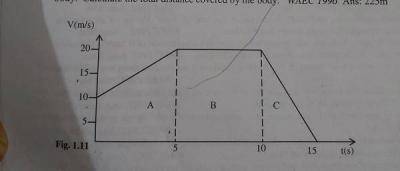
The diagram below illustrates the velocity-time graph of the motion of a body. Calculate the total distance covered by the body
- A. 50m
- B. 65m
- C. 175m
- D. 225m
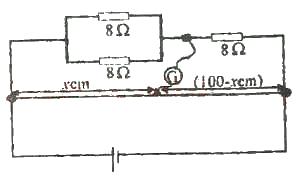
The diagram below shows a balanced metre bridge, the value of x is
- A) 75.0 cm
- B) 66.7 cm
- C) 33.3 cm
- D) 25.0 cm
(a)(i) State Hooke's law. (ii) A spring has a length of 0.20 m when a mass of 0.30 kg hangs on it, and a length of 0.75 nm when a mass of 1.95 kg hangs on it. Calculate the: (i) force constant of the spring; (ii) length of the spring when it is unloaded. [g = 10m/s\(^2\)]
(b)(i) What is diffusion? (ii) State two factors that affect the rate of diffusion of a substance. (iii) State the exact relationship between the rate of diffusion of a gas and its density.
(c) A satellite of mass, m orbits the earth of mass. M with a velocity, v at a distance R from the centre of the earth. Derive the relationship between the period T, of orbit and R.
View Discussion (0)WAEC 2021 THEORYFor semi conductor to have negative temperature coefficient of resistance implies that
- A. their resistance decrease with temperature
- B. The resistance increase with temperature
- C. their resistance is constantly changing with temperature
- D. they have electrons and holes at high temperature