

Physics Past Questions And Answers
A pipe closed at one end is 1.0m long. The air in the pipe is set into vibration and a fundamental note of frequency 85Hz is produced. Calculate the velocity of sound in the air. (Neglect end correction).
- A. 340.0ms-1
- B. 33Oms-1
- C. 170ms-1
- D. 85.0ms-1
An electron moves from an energy level of -8.6 eV to another level of -3.5 eV. Determine the frequency of the absorbed radiation. [1 eV = 1.6 × \(10^{19}\) J, h = 6.6 × \(10^{34}\) Js]
- A. \( 2.93 \times 10^{15}\)Hz
- B. \( 3.59 \times 10^{16}\)Hz
- C. \( 5.39 \times 10^{15}\)Hz
- D. \( 1.24 \times 10^{15}\)Hz
A ball is swung in a horizontal circle of centre O with a constant speed. acceleration?
- A. Away from O
- B. Along the Circumference of the circle
- C. Toward centre O
- D. Along a tangent to the circle
(a) (i) Define Optical angle.
(ii) Explain two conditions necessary for total internal reflection to occur.
(iii) List three practical applications of total internal reflection.
(b) State two effects of refraction.
(c)(i) Define progressive waves.
(ii) A plane progressive wave is represented by the equation y = 0.5 sin(1000\(\pi\)r = \(\frac{100 \pi \lambda}{17}\)) where y is in millimetres, t in seconds and x in metres. Calculate the: (\(\alpha\)) frequency of the wave; (\(\beta\))of the wave; (\(\gamma\)) speed of the wave
View Discussion (0)WAEC 2020 THEORYThe diagram below is a micrometer screw gauge. Determine its reading.
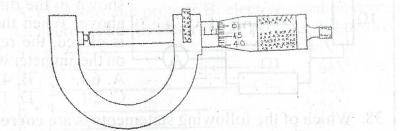
- A. 2.44mm
- B. 2.46mm
- C. 2.86mm
- D. 2.96mm
The duality of matter implies that matter
- A. exists as a particle of dual composition
- B. has momentum and energy
- C. has both wave and particle properties
- D. is made up of dual materials
Which of the following has no effect on radiation?
- A) nature of surface
- B) density
- C) surface area
- D) temperature
One of the following is a scalar quantity?
- A. weight
- B. momentum
- C. potential energy
- D. moments
An engine of a car of power 80 kW moves on a rough road with a velocity of 32 ms-1. The forces required to bring it to rest is
- A) 2.56 x 10⁶N
- B) 2.50 x 10⁶N
- C) 2.80 x 10³N
- D) 2.50 x 10³N
An aluminium rod of length 1.8m at 10°C is heated to proceed produce a difference in length of 0.007m. Calculate the temperature to which it is heated. (Linear expansivity of aluminium = 2.3 x 10\(^{-5}\)K\(^{-1}\)
- A. 155oC
- B. 160oC
- C. 169oC
- D. 179oC