

Mathematics Past Questions And Answers
Given that \(f '(x) = 3x^{2} - 6x + 1\) and f(3) = 5, find f(x).
- A. \(f(x) = x^{3} - 3x^{2} + x + 20\)
- B. \(f(x) = x^{3} - 3x^{2} + x + 31\)
- C. \(f(x) = x^{3} - 3x^{2} + x + 2\)
- D. \(f(x) = x^{3} - 3x^{2} + x - 13\)
Evaluate \(\int_{\frac{1}{2}}^{1} \frac{x^{3} - 4}{x^{3}} \mathrm {d} x\).
- A. -5.5
- B. -2.0
- C. 2.0
- D. 5.5
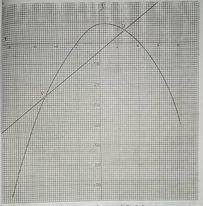
The graph shows the relation of the form y = mx\(^2\) + nx + r, where m, n and r are constants.
Using the graph:
(a) state the scale used on both axes; (b) find the values of m, n and r; (c) find the gradient of the line through P and Q; (d) state the range of values of x for which y > Q.
View Discussion (0)WAEC 2022 THEORYFind the value of x in the diagram
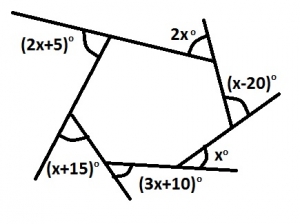
- A. 31°
- B. 35°
- C. 37°
- D. 41°
The derivatives of (2x + 1)(3x + 1) is
- A. 12x + 1
- B. 6x + 5
- C. 6x + 1
- D. 12x + 5
A school boy lying on the ground 30m away from the foot of a water tank tower observes that the angle of elevation of the top of the tank 60o. Calculate the height of the water tank.
- A. 60m
- B. 30√3m
- C. 20√3m
- D. 10√3m
A car uses one litre of petrol for every 14km. If one litre of petrol cost N63.00, how far can the car go with N900.00 worth of petrol?
- A. 420Km
- B. 405Km
- C. 210Km
- D. 200Km
Simplify: \(\frac{x^2 - y^2}{(x + y)^2} + \frac{(x - y)^2}{(3x + 3y)}\)
- A. \(\frac{x - y}{3}\)
- B. x + y
- C. \(\frac{3}{x - y}\)
- D. x - y
Express 2.7864 x 10⁻³ to 2 significant figures
- A. 0.28
- B. 0.27
- C. 0.0028
- D. 0.0027
A sector of a circle of radius 7.2cm which subtends an angle of 300° at the centre is used to form a cone. What is the radius of the base of the cone?
- A. 8cm
- B. 6cm
- C. 9cm
- D. 7cm