

Mathematics Past Questions And Answers
The table below shows the marks obtained by forty pupils in a Mathematics test.
| Marks | 0 - 9 | 10 - 19 | 20 - 29 | 30 - 39 | 40 - 49 | 50 - 59 |
| No of pupils | 4 | 5 | 6 | 12 | 8 | 5 |
(a) Draw a histogram for the mark distribution ;
(b) Use your histogram to estimate the mode ;
(c) Calculate the median of the distribution.
View Discussion (0)WAEC 1996 THEORY.jpg)
If Un = kn\(^2\) + pn, U\(_1\) = -1, U\(_5\) = 15, find the values of k and p.
- A. k = -1, p = 2
- B. k = -1, p = -2
- C. k = 1, p = -2
- D. k = 1, p = 2
Simplify; \(\frac{2 - 18m^2}{1 + 3m}\)
- A. \(2 (1 + 3m)\)
- B. \(2 (1 + 3m^2)\)
- C. \(2(1 - 3m)\)
- D. \(2(1 - 3m^2)\)
Given that \(f : x \to x^{2}\) and \(g : x \to x + 3\), where \(x \in R\), find \(f o g(2)\).
- A. 25
- B. 9
- C. 7
- D. 5
A is twice as fast as B and B is thrice as fast as C is. The journey covered by C is 54 minutes will be covered by B in:
- A. 18 min
- B. 27 min
- C. 38 min
- D. 42 min
(a) Without using mathematical tables or calculator, evaluate \(\frac{\frac{3}{2}\log 27 - 3\log 5\sqrt{5}}{\log 0.6}\)
(b) Two linear transformations A and B in the \(O_{xy}\) plane, are defined by :
\(A : (x, y) (x + 2y, -x + y)\)
\(B : (x, y) (2x + 3y, x + 2y)\).
(i) Write down the matrices A and B; (ii) Find the image of the point P(-2, 2) under the linear transformation A followed by B.
View Discussion (0)WAEC 2016 THEORYThe cross section section of a uniform prism is a right-angled triangle with sides 3cm. 4cm and 5cm. If its length is 10cm. Calculate the total surface area
- A. 142cm2
- B. 132cm2
- C. 122cm2
- D. 112cm2
.jpg) In the diagram, three points A, B and C are on the same horizontal ground. B is 15m from A, on a bearing of 053°, C is 18m from B on a bearing of 161°. A vertical pole with top T is erected at B such that < ATB = 58°. Calculate, correct to three significant figures,
In the diagram, three points A, B and C are on the same horizontal ground. B is 15m from A, on a bearing of 053°, C is 18m from B on a bearing of 161°. A vertical pole with top T is erected at B such that < ATB = 58°. Calculate, correct to three significant figures,
(a) the length of AC.
(b) the bearing of C from A ;
(c) the height of the pole BT.
View Discussion (0)WAEC 2001 THEORY.jpg) < PAB = < ABE = 53° (alternate angles)
< PAB = < ABE = 53° (alternate angles)What is the value of m in the diagram?
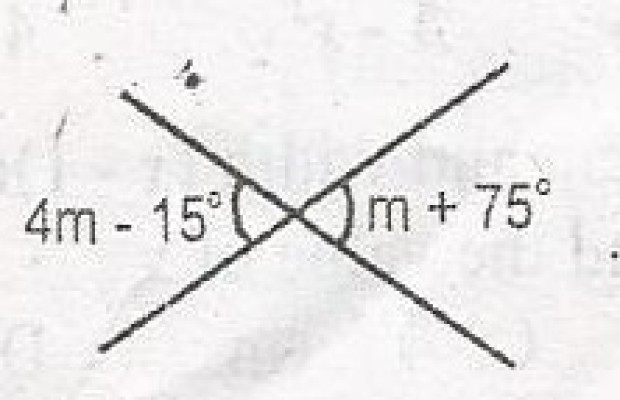
- A. 20°
- B. 30°
- C. 40°
- D. 50°
In the diagram, PQT is a straight line and SQ // RT.
.jpg)
(a) Join QR and show that : (i) < RPS = < QRT ; (ii) < PRS = < QTR.
(b) ABC is a triangle. The sides AB and AC are produced to D and E respectively such that < DBC = 132° and < ECD = 96°. Show that \(\Delta\) ABC is isosceles.
View Discussion (0)WAEC 2003 THEORY_LI.jpg)