

Mathematics Past Questions And Answers
(a) The nth term of a sequence is given by \(T_{n} = 4T_{n - 1} - 3\). If twice the third term is five times the second term, find the first three terms of the sequence.
(b) Given that \(\begin{pmatrix} 2 & 0 & 1 \\ 5 & -3 & 1 \\ 0 & 4 & 6 \end{pmatrix} \begin{pmatrix} 1 \\ m \\ r \end{pmatrix} = \begin{pmatrix} k \\ 2 \\ 26 \end{pmatrix}\), find the values of the constants k, m and r.
View Discussion (0)WAEC 2010 THEORYIf \(P = \sqrt{QR\left(1+\frac{3t}{R}\right)}\), make R the subject of the formula.
- A. \(R = \frac{3Qt}{P^2 - Q}\)
- B. \(R = \frac{P^2
- C. \(R = \frac{P^2 + 3t}{Q - 1}\)
- D. \(R = \frac{P^2-3Qt}{Q}\)
A retailer sells at a discount of 15% of the marked prize. If a customer pays 16,700 for an item.
- A. 19,650
- B. 13,750
- C. 20, 700
- D. 22, 700
Find the range of the value of x satisfying the inequalities 5 + x ≤ 8 and 13 + x ≥ 7
- A. -3 ≤ x ≤ 3
- B. 3 ≤ x ≤ 6
- C. -6 ≤ x ≤ 3
- D. -6 ≤ x ≤ -3
Triangle OPQ is the solution of the inequalities
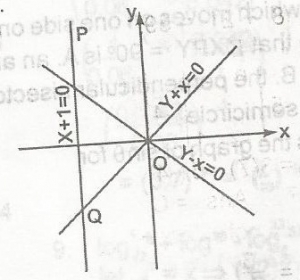
- A. x - 1< 0, y + ≥ 0, y - x ≥ 0
- B. x + 1 ≤ 0, y + x ≥ 0, y - x ≤ 0
- C. x - 1 ≥ 0, y - x ≥ 0, y + x ≥ 0
- D. y + x ≥ 0, y - x ≤ 0
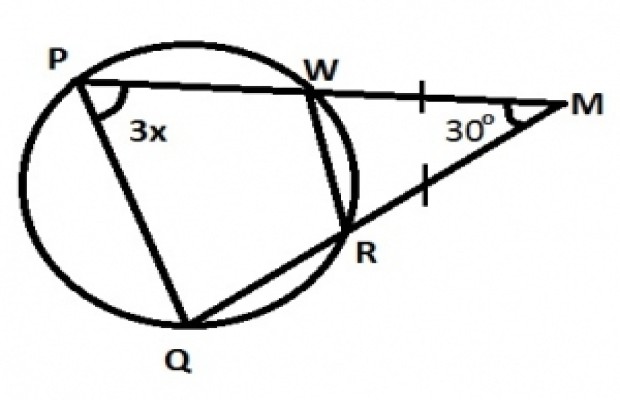
In the diagram, PQRW is a circle. Line P, V and QR are produced to meet at M, where ∠WMR = 30° and |WM| = |MR| Find the value of x
- A. 10°
- B. 25°
- C. 35°
- D. 60°
A company has increased its monthly profit from N12,500 to N17,800. By what percentage did their profit increase?.
- A. 29.3%
- B. 36.7%
- C. 42.4%
- D. 53.9%
If α and β are roots of x\(^2\) + mx - n = 0, where m and n are constants, form the
| equation | whose | roots | are | 1 α | and | 1 β | . |
- A. mnx\(^2\) - n\(^2\) x - m = 0
- B. mx\(^2\) - nx + 1 = 0
- C. nx\(^2\) - mx + 1 = 0
- D. nx\(^2\) - mx - 1 = 0
Simplify \(\frac{1}{3-√2}\) in the form of p + q√2
- A. \(\frac{7}{3}\) - \(\frac{1}{7?2}\)
- B. \(\frac{7}{3}\) + \(\frac{1}{7?2}\)
- C. \(\frac{3}{7}\) - \(\frac{1}{7?2}\)
- D. \(\frac{3}{7}\) + \(\frac{?2}{7}\)
If the quadratic equation \((2x - 1) - p(x^{2} + 2) = 0\), where p is a constant, has real roots :
(a) show that \(2p^{2} + p - 1 < 0\);
(b) find the values of p.
View Discussion (0)WAEC 2010 THEORY