

Jamb 1999 Geography Past Questions And Answers
The sequence of savannah vegetation zones in Nigeria towards the northern part is
- A. Derived, Sahel, Guinea and Sudan
- B. Derived, Guinea, Sudan and Sahel
- C. Derived, Sudan, Guinea and Sahel
- D. Derived, Guinea, Sahel and Sudan
The group of countries that produce most of the cocoa in West Africa is
- A. Ghana, Sierra Leone and Gambia
- B. Ghana, Cote d'Ivoire and Republic of Benin
- C. Ghana, Nigeria and Cote d'Ivoire
- D. Nigeria, Cote d'Ivoire and Togo
Oil refineries are found in which of the following sets of states?
- A. Cross River, Rivers and Edo
- B. Edo, Delta and Kaduna
- C. Cross River, Edo and Kaduna
- D. Rivers, Delta and Kaduna
An African port that handles more of other countries products than its own is
- A. Sofala (Beira)
- B. Cape Town
- C. Luanda
- D. Mombasa
A traveller crossing the international Date Line from America to Asia at 12 midnight on Sunday, would have to change his watch to 12 midnight on
- A. Sunday
- B. Monday
- C. Tuesday
- D. Saturday
In Nigeria, hydroelectric and thermal energies are generated respectively in
- A. Ijora and Oji river
- B. Afam and Ijora
- C. Kainji and Oji river
- D. Kura falls and Kainji
The main use of the Abney Level in surveying is to determine the
- A. angle of inclination
- B. relative location
- C. area coverage
- D. spot height
Which of the following groups of people is not found in West Africa?
- A. Wolof
- B. Mandingo
- C. Mossi
- D. Shona
Many industries in Europe and America have established branches in South East Asia in order to reduce
- A. production costs
- B. transport costs
- C. raw material shortages
- D. comparative advantage
The distance between the two confluences along River Kedi is
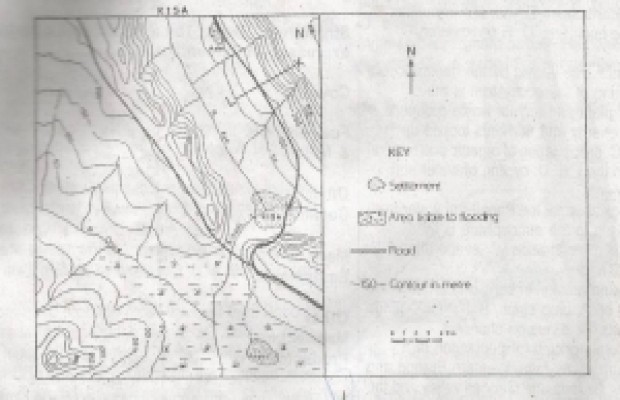
- A. 9.7km
- B. 10.7km
- C. 11.7km
- D. 12.7km