

FURTHER MATHEMATICS Past Questions And Answers
The velocity of a body of mass 4.56 kg increases from \((10 ms^{-1}, 060^o) to (50 ms ^{-1}, 060^o)\) in 16 seconds . Calculate the magnitude of force acting on it.
- A. 17.1 N
- B. 11.4 N
- C. 36.5 N
- D. 5.7 N
(a) Differentiate \(\frac{x^{2} + 1}{(x + 1)^{2}}\) with respect to x.
(b)(i) Evaluate \(\begin{vmatrix} 1 & 2 & -1 \\ 2 & 3 & -1 \\ -1 & 1 & 3 \end{vmatrix}\).
(ii) Using the answer in (b)(i), solve the system of equations.
\(x + 2y - z = 4\)
\(2x + 3y - z = 2\)
\(-x + y + 3z = -1\).
View Discussion (0)WAEC 2013 THEORYTwo balls are drawn, from a bag containing 3 red, 4 white and 5 black identical balls. Find the probability that they are all of the same colour.
- A. \(\frac{5}{33}\)
- B. \(\frac{13}{66}\)
- C. \(\frac{8}{53}\)
- D. \(\frac{19}{66}\)
Find thefifth term in the binomial expansion of \((q + x)^7\).
- A. \(21q^2x^5\)
- B. \(21q^4x^3\)
- C. \(35q^3x^4\)
- D. \(35q^5x^2\)
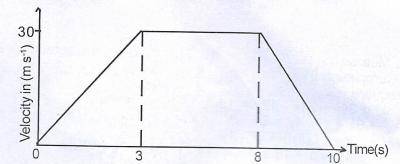
The diagram below is a velocity- time graph of a moving object. Calculate the distance travelled when the acceleration is zero.
- A. 300 m
- B. 90 m
- C. 150 m
- D. 210 m
A particle is projected vertically upwards with a speed of 40 m/s. At what times will it be 35m above its point of projection? \(\text{Take g} = 10 ms^{-2}\)
- A. 1 sec and 7 sec
- B. 1 sec and 8 sec
- C. 2 sec and 5 sec
- D. 2 sec and 7 sec
If \((2x^{2} - x - 3)\) is a factor of \(f(x) = 2x^{3} - 5x^{2} - x + 6\), find the other factor
- A. (x - 2)
- B. (x - 1)
- C. (x + 1)
- D. (x + \(\frac{3}{2}\))
Using binomial expansion of ( 1 + x)\(^6\) = 1 + 6x + 15x\(^2\) + 20x\(^3\) + 6x\(^5\) + x)\(^6\), find, correct to three decimal places, the value of (1.998))\(^6\)
- A. 63.616
- B. 63.167
- C. 62.628
- D. 62.629
Find the variance of 11, 12, 13, 14 and 15.
- A. 2
- B. 3
- C. \(\sqrt{2}\)
- D. 13
The line \(2y = x + 3\) meets the circle \(x^{2} + y^{2} - 2x + 6y - 15 = 0\) at points M and N, where N is in the first quadrant. Find the coordinates of M and N.
View Discussion (0)WAEC 2013 THEORY