

FURTHER MATHEMATICS Past Questions And Answers
(a) Edem and his wife were invited to a dinner by a family of 5. They all sat in such a way in such a way that Edem sat next to his wife. Find the number of ways of seating them in a row.
(b) A bag contains 4 red and 5 black identical balls. If 5 balls are selected at random, one after the other with replacement, find the probability that :
(i) a red ball was picked 3 times ; (ii) a black ball was picked at most 2 times.
View Discussion (0)WAEC 2015 THEORYEvaluate : \(\int_{1}^{3} (\frac{x - 1}{(x + 1)^{2}}) \mathrm {d} x\).
View Discussion (0)WAEC 2017 THEORYThe sum of the first n terms of a linear sequence is \(S_{n} = n^{2} + 2n\). Determine the general term of the sequence.
- A. n + 1
- B. 2n + 1
- C. 3n + 1
- D. 4n + 1
Find the coefficient of the \(6^{th}term\) in the binomial expansion of \((1 - \frac{2x}{3})10\) in ascending powers of \(x\).
- A. \(-\frac{896x^6}{9}\)
- B. \(-\frac{896x^5}{9}\)
- C. \(-\frac{896x^5}{27}\)
- D. \(-\frac{896x^6}{27}\)
Three forces \(-63j , 32.14i + 38.3j\) and \(14i - 24.25j\) act on a body of mass 5kg. Find, correct to one decimal place, the :
(a) magnitude of the resultant force ;
(b) acceleration of the body.
View Discussion (0)WAEC 2012 THEORYFind the value of x for which 6\(\sqrt{4x^2 + 1}\) = 13x, where x > 0
- A. \(\frac{6}{5}\)
- B. \(\frac{25}{24}\)
- C. \(\frac{24}{25}\)
- D. \(\frac{5}{6}\)
(a) Given that \(x = 3i - j, y = 2i + kj\) and the cosine of the angle between x and y is \(\frac{\sqrt{5}}{5}\), find the values of the constant k.
(b) In the quadrilateral ABCD,
.jpg) \(\overrightarrow{AB} = \begin{pmatrix} -5 \\ -1 \end{pmatrix}, \overrightarrow{AC} = \begin{pmatrix} -6 \\ -9 \end{pmatrix}\)
\(\overrightarrow{AB} = \begin{pmatrix} -5 \\ -1 \end{pmatrix}, \overrightarrow{AC} = \begin{pmatrix} -6 \\ -9 \end{pmatrix}\)
and \(\overrightarrow{BD} = \begin{pmatrix} 4 \\ -7 \end{pmatrix}\). Show whether or not ABCD is a parallelogram.
View Discussion (0)WAEC 2014 THEORYHow many numbers greater than 150 can be formed from the digits 1, 2, 3, 4, 5 without repetition?
- A. 91
- B. 191
- C. 291
- D. 391
(a) A body of mass 5 kg is placed on a smooth plane inclined at an angle 30° to the horizontal. Find the magnitude of the force: (i) acting parallel to the plane (ii) required to keep the body in equilibrium. [Take g = \(10 ms^{-2}\)].
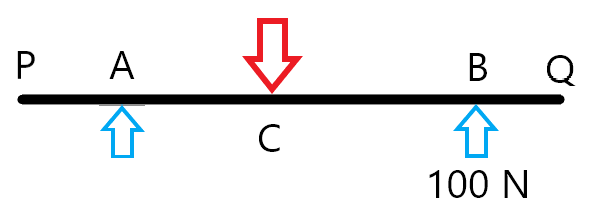
(b) A uniform plank PQ of length 10m and mass m kg rests on two supports A and B, where |PA| = |BQ| = 1m. A load of mass 8 kg is placed on the plank at point C such that |AC| = 3.5 m. If the reaction at B is 100 N, calculate the (i) value of m (ii) reaction at A. [Take g = \(10 ms^{-2}\)].
View Discussion (0)WAEC 2006 THEORY.jpg)
Given that (p + 1/2√3)(1 - √3)\(^2\) = 3- √3,
find x the value of p.
View Discussion (0)WAEC 2021 THEORY