

Economics Past Questions And Answers
2891
which of the following does not change in the short run?
- A. Variable cost
- B. marginal cost
- C. total cost
- D. fixed cost
2892
Scale of preference refers to?
- A. consumers preference for luxury goods
- B. the household monthly income
- C. list of goods and services in order of priority
- D. budget perparation without paying due regard to priority
2893
A movement along the same demand curve either upwards or downwards as a result of change in price implies
- A. a chnage in demand
- B. a change in quantity demanded
- C. an increase in demand
- D. a shift in the demand curve to the right
2894
In perfectly elastic supply, the supply curve
- A. is vertical
- B. is horizontal
- C. slopes downward
- D. slopes upward
2895
Government participation in the oil industry was necessitated by the
- A. annual increase in production
- B. formation of OPEC
- C. high demand for crude oil
- D. huge investment outlay
2896
Labor productivity is defined as
- A. output per man-hour
- B. average Output
- C. the maximum number of hours Worked
- D. total output of labour
2897
In the theory of the consumer behavior, a consumer is said to maximize utility when
- A. Marginal utility of a commodity is equal to the price paid for it
- B. Marginal utility of a commodity X is equal to the price of commodity Y
- C. Average utility of a commodity is equal to the price paid for it
- D. Total utility of a commodity is equal to the price paid for it
2898
From the diagram shown, the optional point of production is_____________?
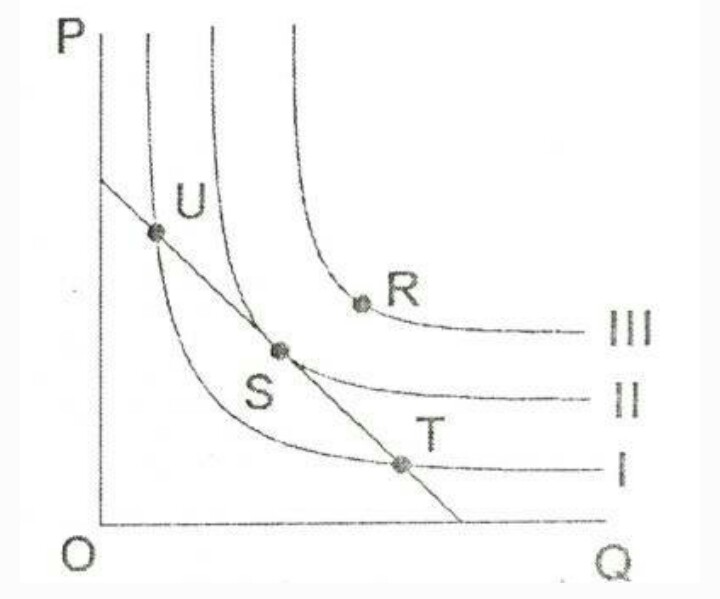
- A. R
- B. T
- C. S
- D. U
2899
How many units of good X is produced for 8 units of commodity Y?
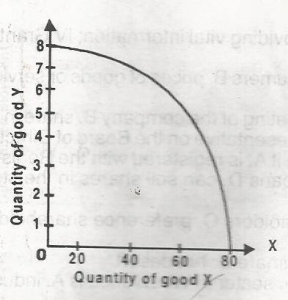
- A. 80
- B. 40
- C. 20
- D. O
2900
Explain the advantages and disadvantages of monopoly.
View Discussion (0)WAEC 1999 THEORY