

Economics Past Questions And Answers
1831
the largest part of the revenue of a country is derived from
- A. direct taxation
- B. indirect taxation
- C. excise duties
- D. company taxes
1832
How many student took the examination?
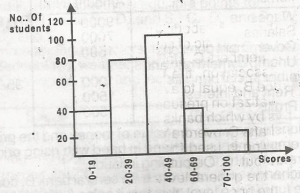
- A. 280
- B. 240
- C. 200
- D. 80
1833
The value of money is generally measured in relation to the
- A. interest rate charged on the bank loans
- B. general price level
- C. size of a country's gold stock
- D. volume of imports
1834
If government expenditure exceeds revenue, this result in
- A. balanced budget
- B. national debt
- C. budget deficit
- D. budget surplus
1835
An economy in which both the public and private sectors contribute to economic growth is a__________?
- A. socialist economy
- B. feudal economy
- C. mixed economy
- D. capitalist economy
1836
The median of an odd-numbered set of scores is the
- A. Middle value in the set
- B. Highest value in the set
- C. Arithmetic means of the set
- D. Most frequent occuring score
1837
The outward shift to the production possibility curve could be due to
- A. military conquest
- B. increased money supply
- C. inflation
- D. economic growth
1838
The consumer-goods industry is predominant in the industrial sector of the Nigerian economy because of the?
- A. availability of market and most of the raw materials required
- B. availability of the necessary machinery required
- C. experience of Nigerian producers
- D. relatively lower cost of production of such goods
1839
Contractionary monetary policy is used to
- A. control inflation
- B. bridge the deflationary gap
- C. expand the output level
- D. deregulate the economy
1840
A major assumption in a perfectly competitive market is that
- A. the number of buyers and sellers is small
- B. individuals cannot influence prices
- C. the quality of products remains the same
- D. prices will always remain constant