

Economics Past Questions And Answers
The supply of commodity II increasing from S 1 S 1 to S 2 S 2
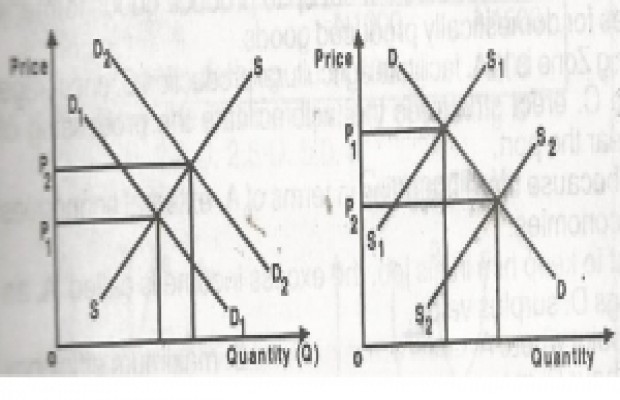
- A. Moves the price below OP 2
- B. Leads to a fall in price from OP 1 to OP 2
- C. Increases the price from OP 2 to OP 1
- D. Moves the price to OP 1
(a) Explain any two causes of a declining population:
(b) Outline any three factors which determine the size of your country's working population.
View Discussion (0)WAEC 2004 THEORYWhat is National income and its importance.
View Discussion (0)WAEC 1990 THEORYAbstention from consumption enables capital to be produced . Such abstention is called
- A. savings
- B. production
- C. accumulation
- D. factors of production
If the demand for one commodity excludes another, it is said to be
- A. complementary demand
- B. competitive demand
- C. composite demand
- D. derived demand
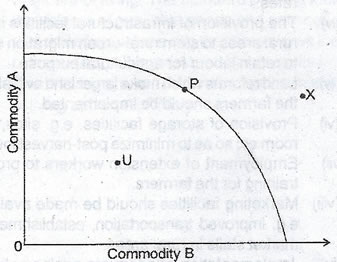
(a) What is production possibility curve? (3marks)
(b) Draw a production possibility curve and indicate any:
(i) Point P, where resources are fully utilized;
(ii) Point U, where resources are under utilized;
(iii) Point X, where production is not feasible. (8 marks)
(c) Explain anytwofactors that can make production at Point X feasible. (6marks).
(d) Why is the production possibility curve negatively sloped? (3marks)
Collectivism refers to the management of state enterprises in a?
- A. mixed economy
- B. co-operative organizations
- C. capitalist economic system
- D. socialist economy
If a total cost curve is plotted, marginal cost can be illustrated by the?
- A. slope of the tangent to the curve at any given output
- B. U-shaped curve cutting the total cost curve at its lowest point
- C. straight line from the origin to the mid-point of the curve
- D. straight line cutting the curve at its highest point
Demand for inferior goods is an example of
- A. expansion of demand
- B. contraction of demand
- C. individual demand
- D. abnormal demand
The type of unemployment found among workers who leave their jobs in search of other jobs is termed
- A. seasonal unemployment
- B. structural unemployment
- C. frictional unemployment
- D. cyclical unemployment