

Economics Past Questions And Answers
1411
A situation in which a commodity is sold abroad below its cost of production in the home country is known as?
- A. dumping
- B. counter trade
- C. bilateral trade
- D. trade liberalization
1412
The total value of goods and services produced within the borders of a country is
- A. net national product
- B. net domestic product
- C. gross domestic product
- D. gross national product
1413
The marketing of agricultural commodities in Nigeria is hampered by
- A. lack of adequate storage facilities
- B. the existence of farmers' associations
- C. the existance of commodity exchange
- D. the abolition of marketing boards
1414
a situation of full employment exist when
- A. every adult is employed
- B. all adukts who can work are employed
- C. all persons who have attained the age of 15 years and above are employed
- D. all those who are able and eligible to work are employed
1415
Profits can be calculated by
- A. subtracting total cost from total revenue
- B. subtracting average revenue from total cost
- C. dividing total revenue from total output
- D. dividing marginal revenue by marginal cost
1416
THE RELATIONSHIP BETWEEN TAX RATE AND INCOME WHICH IS RELEVANT TO A PROPORTIONAL TAX IS DEPICTED BY
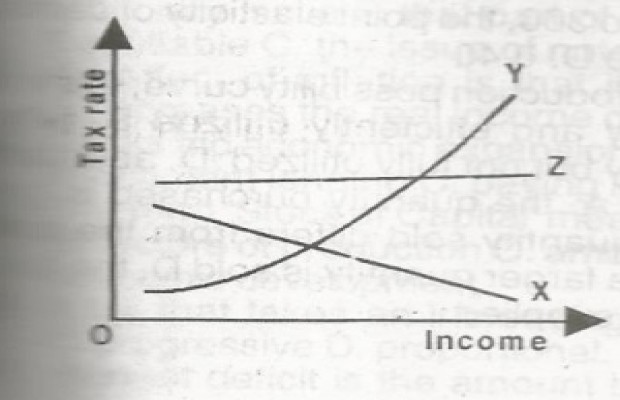
- A. CURVES Z AND Y
- B. CURVE X
- C. CURVE Z
- D. CURVE Y
1417
A rising short-run average cost is a result of
- A. economies of scale
- B. falling marginal costs
- C. diminishing returns
- D. rising fixed costs
1418
The Gross Domestic Product is defined as the total value of?
- A. all final goods and services produced in a country during the year
- B. all assets of a country in a particular year
- C. exports net of total value of imports
- D. all receipts
1419
The price elasticity of supply of perishable goods is_________?
- A. Elastic
- B. Unitary
- C. Inelastic
- D. Zero
1420
If the equilibrium price of a certain commodity is N120.00 and the government fixed its price at N110.00, the supply will be?
- A. greater than the equilibrium supply
- B. smaller than the equilibrium supply
- C. the same as the equilibrium supply
- D. a determinant of the market forces of equilibrium