

Economics Past Questions And Answers
Above the equilibrium point, a further rise in price tends to
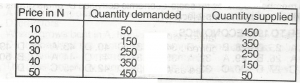
- A. increase demand and restrict supply
- B. restrict demand and decrease supply
- C. increase demand and decrease supply
- D. decrease demand and increase supply
Economists refer to private goods as
- A. rivalrous and non-excludable
- B. rivalrous and excludable
- C. non rival and non- excludable
- D. non rival and excludable
which of the following is an implication of a large population
- A. decrease in crime rate
- B. increase in food supply
- C. decrease in standard of living
- D. decrease in cost of living
Total cost is the addition of
- A. real cost and money cost
- B. price and taxes
- C. fixed cost and variable cost
- D. average cost and marginal cost
(a) What is a trade union?
(b) Describe any four functions of trade unions.
(c) Outline any two weapons used by trade unions to achieve their objectives.
View Discussion (0)WAEC 2015 THEORYWhich of the following rewards is associated with entrepreneurship
- A. salaries
- B. profits
- C. interest
- D. rent
One of the fundamental differences between a capitalist and a socialist economy is that while?
- A. the former is characterized by complete government ownership of resources, the latter characterized by complete private ownership
- B. in the former, prices act as signals in the allocation of resources, it is central authority that performs this function in the letter
- C. taxes are levied in a capitalist economy, there is no taxation in a capitalist economy
- D. income and wealth are equally distributed in the socialist economy, this is not so in a capitalist economy
If labour productivity in the cement industry is increasing as output of cement is expanded, then the amount of labour per unit of output produced must be?
- A. less than zero
- B. decreasing
- C. constant
- D. increasing
Give five reasons why Government participates in business enterprise.
View Discussion (0)WAEC 1995 THEORYA shift of the demand curve to the right when the supply curve remains constant , implies that
- A. both price and quantity demanded will increase
- B. only price increases
- C. both price and quantity demanded will decrease
- D. the price remains constant