Waec 2019 Chemistry Past Questions And Answers
If a catalyst is added to a system, the temperature and the pressure remain constant, there would be no effect on the?
- A. activation energy of the reaction
- B. rate of the reaction
- C. rate of the reverse reaction
- D. heat of reaction
(a) Explain briefly why \(_2^4He\) has a stable electron configuration compared to \(_4^9Be\)
(b) Consider the following elements: 1H and 3Li.
(i) State the number of electrons that an atom of each element would have after forming an ionic bond.
(ii) Give a reason for each of your answers stated in (b)(i).
(c) Statetwo factors that should be considered when siting a chemical industry.
(d) Statetwo advantages of using a catalyst instead of high temperatures in chemical reactions.
(e) Turpentine burns in chlorine according to the following equation:
C\(_{10}\)H\(_{16}\)\(_{(I)}\) + 8Cl\(_{2(g)}\) \(\to\) 10C\(_{(s)}\) + 16HCl\(_{(g)}\)
Calculate the mass of turpentine that would completely burn in 21.3 g of chlorine.
[Molar mass of chlorine = 71 gmol\(^{-1}\); Molar mass of Turpentine = 136 gmol\(^{-1}\)]
(f) What is cracking?
(g) Statetwo factors that may influence the value of electron affinity.
(h) What are carbohydrates?
(i) Statetwo differences between a simple sugar and starch.
(j) Write an equation to show the dissociation ofeach of the following acids:
(i) H\(_2\)CO\(_3\);
(ii) CH\(_3\)COOH.
View Discussion (0)WAEC 2019 THEORYconsider the following reaction equation: 2NH3 .+ 3Cl2 → N2 + 6HCl. NH3 is acting as?
- A. a reducing agent
- B. a dehydrating agent
- C. a drying agent
- D. an oxidizing agent
Biotechnology is applied in the?
- A. treatment of sewage
- B. treatment of water
- C. purification of chemicals
- D. purification of metals
If 6.5g of magnesium ribbon reacts completely with Hydrochloric acid, how many grams of hydrogen gas would be liberated? Mg(s) + 2HCl(aq) --> MgCl2(aq) + H2(g) [ H = 1.0, Mg = 24.0 ]
- A. 0.54g
- B. 0.70g
- C. 1.08g
- D. 1.40g
The process by which alkanoic acid reacts reversibly with alkanols is known as?
- A. saponification
- B. esterification
- C. carboxylation
- D. halogenation
A solid with higher melting and boiling points is likely to be?
- A. Covalent compound
- B. A Dative compound
- C. An Electrovalent compound
- D. A Non-metal
consider the reaction represented by the following equation: 2SO2 + O2 ⇌ 2SO3 A decrease in the pressure of the reaction would
- A. decrease in the concentration of SO2
- B. have no effect on the reaction
- C. shift the equilibrium position to the left
- D. shift the equilibrium position to the right
When quicklime dissolves in water?
- A. heat is absorbed
- B. heat is evolved
- C. oxygen is liberated
- D. hydrogen is given off
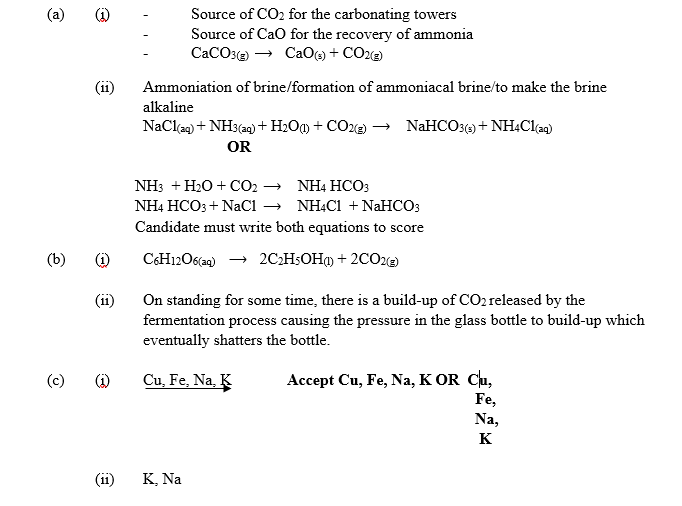
(a) In the Solvay process, explain briefly with equations the functions of the following substances:
- limestone;
- ammonia.
(b) (i) Write a chemical equation for the fermentation of glucose.
(ii) Explain briefly why a tightly-corked glass bottle filled to the brim with fresh palm-wine shatters on standing for some time.
(c) Consider the following metals: Na, Fe, K and Cu.
(i) Arrange the metals in order of increasing reactivity.
(ii) Which of the metals will react with cold water?
(ii) Which of the metals could form coloured salts?
(d)(i) What is aredox reaction?
(ii) Identify which of the following reaction equations are redox.
(I) 2Na + Cl\(_2\) → 2NaCl
(II) AgCl + 2NH\(_3\) → [Ag(NH\(_3\))\(_2\)]Cl
(III) C\(_2\)H\(_2\) + H\(_2\) → C\(_2\)H\(_4\)
(IV) HCl + KOH → KCl + H\(_2\)O
(V) 2FeCl\(_3\) + 2KI → 2FeCl\(_2\) + 2KCl + I\(_2\)
(iii) Give a reason for each of the answers in(d)(ii).
(iv) Write balanced equations of the half reactions for any two of the redox reactions in(d)(ii).