Waec 2007 Chemistry Past Questions And Answers
Glucose reduces Fehling solution on warming to
- A. copper (l) oxide
- B. copper (ll) oxide
- C. copper (l) chloride
- D. copper (ll) hydroxide
Consider the reaction below: Vegetable oil (frac{H2;NI catalyst}{High temperature}) product. The reaction is applied in the manufacture of
- A. drugs
- B. margarine
- C. paraffin wax
- D. soapy detergents
i) What is the name of the process used for the industrial preparation of tetraoxosulphate (VI) acid?
(ii) State the catalyst used in (a)(i)
(iii) Show by means of bdanced chemical equations only, the industrial preparation of tetraoxosulphate (VI) acid from sulphur (IV) oxide.
(b)(i) Distinguish between dehydration and drying
(ii) Explain why concentrated tetraoxosulphate (VI) acid cannot be used to dry ammonia
(iii) What is the drying agent for ammonia?
(c)(i) Give one example of I. a chloride which is soluble in hot water, II. a trioxocarbonate (IV) which does not decompose on heating, Ill. an amphoteric oxide
(ii) List three methods for the preparation of salts
(iii) State one method for the recovery of salt from its solution.
(d)(i) State Gay Lussac's law of combining volumes
(ii) Consider the reaction represented by the following equation: C\(_2\)H\(_{4(g)}\) + 3O\(_{2(g)}\) \(\to\) 2H\(_2\)O\(_{(g)}\) + 2CO\(_{2(g)}\). What is the volume of oxygen required for the complete combustion of 12.5 cm\(^{3}\) of ethene?
View Discussion (0)WAEC 2007 THEORYWhich of the following properties of atoms generally increases down a group in the periodic table?
- A. Electron affinity
- B. Electronegativity
- C. Ionic radius
- D. lonization energy
(a) Define the following terms:(i) Saturated solution; (ii) Solubility.
(b) In an experiment to determine the solubility of a given salt Y, the following data were provided:
Mass of dry empty dish = 7.16 g
Mass of dish + saturated solution of salt Y = 17.85 g
Mass of dish + salt Y = 9.30 g Temperature of solution = °C
Molar mass of salt Y = 100
Density of solution Y = 1.00 g cm\(^{-3}\) Calculate the solubility of salt Y in
(i) g dm\(^{-3}\) of solution, (ii) mol dm\(^{-3}\) of solution.
(c) State the type of bond broken on melting each of the following substances: (i) NaCI\(_{(s)}\) (ii) CO\(_{2(s)}\) (iii) SiO\(_{2(s)}\) (iv) Al\(_{(s)}\)
(d) Explain the following observations: (i) the chemical reactivity of alkali metals increases down the group; (ii) Mg has higher melting point than Na; (iii) K is a better reducing agent than Na.
(e)(i) What are isotopes? (ii) Lithium exists as \(^6_3\)Li and \(^7_3\)Li in the ratio 2:25. Calculate the relative atomic mass of the lithium.
View Discussion (0)WAEC 2007 THEORYWhich of the following statements about rare gases are correct?
- A. Their outermost shells are fully filled
- B. They are generally unreactive
- C. Their outermost shells are partially filled
- D. They have lone pair of
(a)(i) What is 2 homologous series?
(ii) Give two homologous series present in petroleum
(iii) Give one example of a compound belonging to each of the homologous series in (a)(ii).
(iv) Name two fractions obtained from the fractional distillation of petroleum
(v) Why is there a gradual change in the physical properties of petroleum fractions?
b) Write a two-step balanced chemical equation for the reaction of (i) ethanol with excess concentration traoxosulphate (VI) acid at high temperature
(ii) excess ethanol with concentrated tetraoxosulphate (VI) acid at lower temperature.
(c) An organic compound of relative molecular mass 46, on analysis vas ound to contain 52.0% carbon, 13.3% hydrogen and 34.7% oxygen.
(i) Determine its I. empirical formula, II. molecular formula.
(ii) Draw two possible structures of the compound and name one of them [O = 16; C = 12; H = 1 ]
View Discussion (0)WAEC 2007 THEORYThe complete hydrogenation of C6 H6 in the presence of nicked catalyst at 200°C gives
- A. C6H8
- B. C6H10
- C. C6H12
- D. C6H14
When air is successively passed through sodium hydroxide solution, alkaline pyrogallol and then concentrated tetraoxosulphate (VI) acid, its remaining components are
- A. oxygen and water vapour
- B. oxygen and nitrogen
- C. carbon (IV) acid and noble gases
- D. nitrogen and noble gases
a) Define the following in term:. of electron transfer: (i) oxidation; (ii) reduction.
(b)(i) Determina the oxidation stale of phosphorus in each of the following structures: I. POCI\(_3\) II. PH\(_3\).
(ii) State with reasons whether the following compounds will form acidic, neutral or basic aqueous solutions: I. NaNO\(_3\) II. Na\(_2\)H\(_4\)CI; Ill. Na\(_2\)CO\(_3\).
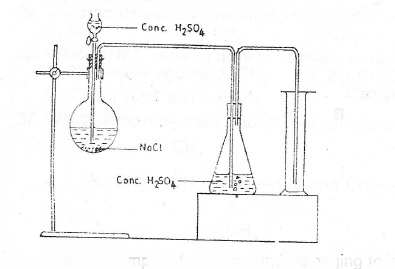
(c) Consider the set-up
(i) What is the gas produced in the experiment illustrated by the set-up above?
(ii) Name the method of collection of gas
(iii) Give a reason for your answer in (c)(ii) above
(iv) State the function of the concentrated H\(_2\)SO\(_4\) in the conical flask
(v) Give of collection of the gas one I. physical property; II. chemical property of the gas
(vi) State one chemical test to identify the gas.
(d) A 4.3 g hydrated sodium tetraoxosulphate (VI) (Na\(_2\)SO\(_4\).xH\(_2\)O) was heated to remove the water of crystallization. The remaining anhydrous salt had a mass of 2.12 g. Calculate the value of x in the t I hydrated salt. [H = 1; O = 16; Na = 23; S = 32 ]