

Chemistry Past Questions And Answers
771
Coffee stains can best be removed by
- A) Kerosine
- B) turpentine
- C) a solution of borax in water
- D) ammonia solution
772
How many moles are there in 3.0 g of O2? [O = 16.0]
- A. 0.0093 moles.
- B. 0.0930 moles.
- C. 0.0625 moles.
- D. 0.6250 moles.
773
8g CH4 occupies 11.2 dm3 at s.t.p. What volume would 22 g of CH3CH3 occupy under the same condition? (C = 12, H = 1)
- A. 3.7 dm3
- B. 11.2 dm3
- C. 22.4 dm3
- D. 33.6 dm3
774
CH4(g) + 2O2(g) → 2H2O(l) + CO2(g) ΔH = 890KJ/mol. ΔH in the reaction represented by the equation above is the enthalpy of
- A. formation
- B. combustion
- C. solution
- D. activation
775
Which of the following apparatus is NOT used in volumetric analysis?
- A. Pipette
- B. Burette
- C. Desiccator
- D. conical flask
776
Copper metal dissolves in concentrated trioxonitrate (V) acid with the resultant evolution of
- A) CO2
- B) SO2
- C) NO2
- D) CO
777
Z in diagram below represents
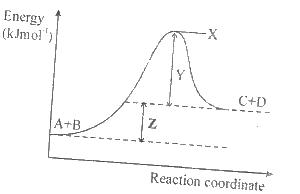
- A) heat of reaction
- B) activation energy
- C) free energy
- D) entropy of reaction
778
How many grams of hydrogen gas will be liberated when 6g of magnesium ribbon dissolves in 500cm3 of 6M HCl? (Mg = 24, H = 1, Cl = 33.57)
- A) 1.0
- B) 1.5
- C) 0.5
- D) 2.0
779
Water can be identified by the use of?
- A. anhydrous copper (II) tetraoxosulphate (VI)
- B. anhydrous sodium trioxocarbonate (IV)
- C. potassium heptaoxochromate (VII)
- D. copper (II) trioxocaronate (IV)
780
In the oil drop experiment, Millikan determined the?
- A. charge to mass ratio of the electron
- B. mass of the electron
- C. charge of the electron
- D. mass of the proton