

Chemistry Past Questions And Answers
The compound, when refluxed with dilute HCl, is hydrolyzed to give
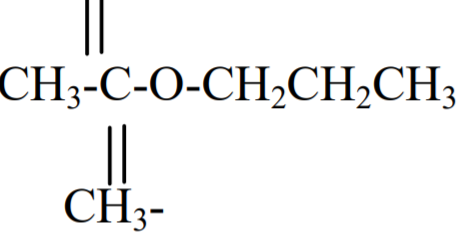
- A) CH3COOH and CH3CH2CH2OH
- B) CH3COOH and CH3CH2CH3
- C) CH3COOH and CH3CH2OH
- D) CH3COOH and CH3CH2CH2Cl
Which of the following modes of motion is exhibited by the particles of a solid?
- A. Vibrational and random motion
- B. Vibrational and translational motion
- C. Translational and random motion
- D. Vibrational motion only
The IUPAC name of the compound CH3CH(CH3)CHCH2 is
- A. 2 - methyl but - 1 - ene
- B. 2 - methyl but - 2 - ene
- C. 3 - methyl but - 1 - ene
- D. 3 - methyl but - 2 - ene
In the reaction: 2Hl(g) ↔ H2(g) + l2(g)' ΔH = 10 kj; The concentration of iodine in the equilibrium mixture can be increased by?
- A. raising the pressure
- B. raising the temperature
- C. adding a catalyst
- D. lowering the pressure
Which functional group is present in alkanals?
- A. Carbonyl group (C=O)
- B. Hydroxyl group (-OH)
- C. Alkyl group (-R)
- D. Carboxyl group (-COOH)
A dense white fume is formed when ammonia gas reacts with
- A. O2(g)
- B. H2(g)
- C. Cl2(g)
- D. HCl(g)
(a)(i) Define allotropy.
(ii) Name the allotrope of carbon used in gas masks.
(iii) Mention two other elements which exhibit allotropy apart from carbon.
(b) List the products of each of the following reactions:
(i) Heating coal in the absence of air.
(ii) Burning of candle wax in plentiful supply of air
(c)(i) State the two properties of carbon (IV) oxide which make it useful in extinguishing fire.
(ii) Write an equation for the reaction of carbon (IV) oxide with lime water
(iii) Calculate the volume of oxygen that was in excess if 150cm\(^3\) of carbon (II) oxide was burnt in 80cm\(^3\) of oxygen according to the following equation: 2CO\(_{(g)}\) + O\(_{2(g)}\) \(\to\) 2CO\(_{2(g)}\).
(d)(i) State how nitrogen can be obtained from ammonia gas.
(ii) Name the gaseous fuels obtained when steam and air are passed over red hot coke.
(iii) Which of the fuels in (d)(ii) has the lower heating ability? Give reason for your answer.
View Discussion (0)WAEC 1999 THEORYWhich of the following indicates the correct increasing order of oxidizing power of the halogens?
- A. F< CI< Br< l
- B. l< Br< CI< F
- C. I< CI< Br< F
- D. Br< I< CI< F
A\(_{(g)}\) + 2B\(_{(g)}\) \(\rightarrow\) C\(_{(g)}\)
In the reaction represented by the equation above, the rate of appearance of C is found experimentally to be independent of the concentration of A and to increase four folds when the concentration of B is doubled. The rate law for the reaction is
- A)Rate = \(K[A]^0[B]^4\)
- B)Rate = \(K[A]^0[B]^2\)
- C)Rate = \(K[A][B]^2\)
- D)Rate = \(K[A]^2[B]^0\)
How many atoms are present in 6.0g of magnesium? [Mg=24,N.A=6.02x10^23mol]
- A) 1.20 x 10^22
- B) 2.4 x 10^22
- C) 1.51 x 10^22
- D) 3.02 x 10^22