

Chemistry Past Questions And Answers
Which of the alcohol below is likely to be oxidiezed to give the acid below:
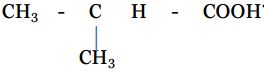
- A) Butan-1-ol
- B) 2-methylpropan-2-ol
- C) 2-Methylpropan-1-ol
- D) Propane-2-ol
Which of the following halogens is liquid at room temperature?
- A. lodine
- B. Chlorine
- C. Bromine
- D. Fluorine
Which of the following gases are diatomic except
- A. nitrogen
- B. helium
- C. hydrogen
- D. fluorine
(a) The letters R,S,T represent an alkene, an alkene and a terminal alkyne respectively. Which of R, S and T typically undergo(es) the following reactions?
(i) Addition reaction;
(ii) Combustion;
(iii) Substitution reaction.
(b)(i) Name the process by which an alkanol can be converted to an alkene.
(ii) Write the name and structural formula of the third member cf the alkanol series.
(iii) State what would be obtained if a primary alkanol reacted with excess acidified KMnO\(_4\) solution.
(c)(i) Give one chemical test for alkanoic acids.
(ii) Write an equation to show how methanoic acid reacts with ethanol in the presence of mineral acids.
(iii) What is the role of mineral acid in the reaction in (c) ii?
(d) In an experiment, cassava was pressure-cooked to release starch granules, followed by treatment with malt for about 2 hours at 55°C. Yeast was then added and the mixture was left for 2 days at 27°C. An organic product J and a gas H were obtained.
(i) Identify H
(ii) State the class of carbohydrates to which starch belongs and explain what happened to the starch during treatment with malt.
(iii) Draw a labelled diagram of a suitable set-up for obtaining a sample of J from the reaction mixture.
View Discussion (0)WAEC 1999 THEORYUranium-235 explodes when bombarded with a slow moving neutron according to the equation below:\(^{235}_{92}U + ^1_0n \rightarrow ^{94}_{36}Kr + Ba + 3^1_0n\)The atomic number and mass of Ba respectively are
- A) 46 and 126
- B) 36 and 116
- C) 56 and 139
- D) 66 and 146
Which of the following is not a halogen?
- A. Silicon
- B. Fluorine
- C. Astatine
- D. Bromine
The difference between colloids and suspensions is brought out clearly by the fact that while colloids
- A) do not scatter light, suspensions do
- B) can be separated by filtration, suspensions cannot be so separated
- C) can be separated by a membrane, suspensions cannot
- D) do not settle out on standing, suspensions do
Haematite is an ore of
- A. zinc
- B. lead
- C. iron
- D. copper
If 100cm3 of oxygen pass through porous plug in 50 seconds, the time taken for the same volume of hydrogen to pass through the same porous plug is
- A) 10.0s
- B) 12.5s
- C) 17.7s
- D) 32.0s
(a)(i) State Faraday's first law of electrolysis. (ii) Distinguish between a strong electrolyte and a weak electrolyte
(b) State one chemical property of ethyne.
(c)( i) What is meant by the tern unsaturated hydrocarbon? (ii) Complete the following reaction equation: CH\(_3\) + CH\(_3\)OH-> (iii) Name the major product formed in the cation stated in 1(c)(ii).
(d) State one way by which the rate of esterification could be increased.
(e) Consider the reaction represented by the following equation: Zn + H\(_2\)SO4 → ZnOS\(_4\) + H\(_2\) . If 3.75g of Zn dust was added to excess H\(_2\)SO\(_4\). Calculate the number of molecules of hydrogen gas produced. [ Zn = 65.0, Na = 6.02 X10\(^23\) ].
(f) State one effect of global warming.
(g) Consider the following reaction equation:
A. Pb(NO\(_3\)) +H\(_2\)S --> PbS + 2HNO\(_3\);
B. H\(_2\) + C\(_2\)H\(_4\) → C\(_2\)H\(_6\).
C. Zn(OH)\(_2\) + 2OH → [ Zn(OH)\(_4\) ]\(^2\).
(i) Which of the equations represent(s) redox process? (ii) State the change in Oxidation number of the species that are oxidized or reduced. (h)(i) State two of the main concepts of Bohr's model of the atom. (ii) State the limitations of Bohr's model. (i) List three factors that could influence the equilibrium position of a reversible reaction. (j) Calcium trioxocarbonate(iv) powder is added to separate equimolar solutions of hydrochloric acid and ethanoic acid. State one: (i) similarity in the observation in both reactions: (ii) difference in the observation in both reactions.
View Discussion (0)WAEC 2020 THEORY