

Chemistry Past Questions And Answers
An element B, has two isotopes \( ^{20}_{10}B and ^{22}_{10}B = 2:3 \) present in ratio 2:3. The relative atomic mass of B is
- A) 20.5
- B) 21.2
- C) 23.4
- D) 25.0
The key factor to be considered in siting a chemical industry is
- A. favourable climatic conditions
- B. the availability of space to store raw materials
- C. its nearness to other industrial establishments
- D. its nearness to the source of raw materials
What volume of 0.20 mol dm-3 NaOH solution would yield 5.0 g of NaOH on evaporation to dryness? [NaOH = 40g mol-1]
- A. 400 cm3
- B. 625 cm3
- C. 1000 cm3
- D. 1600 cm3
Which of the following ions has the electron configuration 2,8,8?
- A. Na+
- B. Mg2+
- C. F-
- D. CI-
Which of the following statements is true about 2-methylpropane and butane
- A) They have different number of carbon atoms
- B) They are members of same homologous series
- C) They have the same boiling points
- D) They have the same chemical properties
How many grammes of methyl acetylene (propyne) CH3-C=CH will completely discharge the colour of 8g of bromine? (Br = 80, C = 12, H = 1)
- A) 0.5
- B) 1.0
- C) 2.0
- D) 3.0
The lUPAC name for
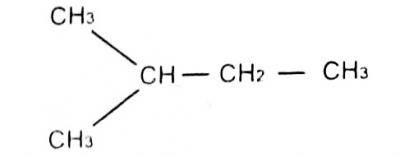
- A) 1-methyl pentane
- B) 3-methylbutane
- C) 2-methylbutane
- D) 1-dimethyl propane
Stoichiometry is based on the law?
- A. multiple proportion
- B. constant composition
- C. conservation of energy
- D. conservation of mass
The metal that liberates hydrogen from cold water in bubbles only is?
- A. Na
- B. K
- C. Ca
- D. Al
The boiling points of HF, H2O and NH3 increase in the order of
- A. NH3
- B. H2O< HF
- C. HF< NH3< H2O
- D. NH3< HF< H2O