

Chemistry Past Questions And Answers
(a)(i) Define the term functional group.
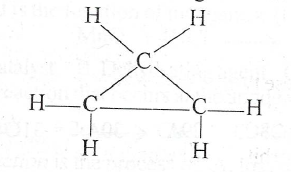
(b) Consider the following structure of an organic compound, Q.
(1) Name compound Q.
(ii) Write the balanced equation for the complete combustion of compound Q.
(iii) What type of reaction will compound Q undergo with chlorine?
(vi) Draw the structure of-the alkene that is an isomer of compound Q.
(c) A chemistry student was provided with four samples of organic compounds, A, B, C, and D. Samples A and B each decolourized bromine in tetrachloromethane but only sample B reacted with a solution of ammoniacal silver trioxonitrate (V) to give a white precipitate. Sample D reacted with sodium trioxocarbonate (IV) to liberate carbon (IV) oxide. When heat was applied to the mixture of samples C and D in a test tube and drops of concentrated tetraoxosulphate (VI) acid added, a product with a fruity odour was formed.
(i) Name the family of organic compounds to which samples A, B, C, and D belong.
(ii) State why samples A and B reacted with bromine in tetrachloromethane.
(iii) State the reason why sample B gave a white precipitate with the solution of ammoniacal silver trioxocarbonate (V).
(iv) Give the name o f the reactions between' samples C and D.
(v) State the two roles of the concentrated tetraoxosulphate (VI) acid in the reaction in (a)(iv).
(d) (i) Describe briefly the production of biogas using a biogas generator.
(ii) State two uses of biogas.
Calculate the volume of carbon (IV)oxide measured at s.t.p, produced when 1 kg of potassium hydrogen trioxocarbonate (IV) is totally decomposed by heat? (G.M.V. at s.t.p 22.4 dm3, K = 39, O = 16, C = 12, H = 1)
- A. 28 dm3
- B. 56 dm3
- C. 112 dm3
- D. 196 dm3
Analysis of a hydrocarbon shows that it contains 0.93g of Carbon per gram of the compound. The mole ratio of carbon to hydrogen in the compound is [H = 1.0, C=12.0]
- A. 1:1
- B. 1:2
- C. 2:1
- D. 2:3
in Boyle's law?
- A. T is constant, P varies directly with V
- B. P is constant, V varies inversely with T
- C. V is constant, P varies directly with T
- D. T is constant, V varies inversely with P
Chlorine, bromine and iodine belong to the same group and
- A. are gaseous at room temperature.
- B. form white precipitate with AgNO3(aq)
- C. react violently with hydrogen without heating
- D. react with alkali
The furring of kettles is caused by the presence in the water of
- A. Calcium tetraoxosulphate (VI)
- B. Calcium hydrogentrioxocarbonate (IV)
- C. Calcium hydroxide
- D. Calcium trioxocarbonate (IV)
Rare gases are stable because they
- A. are chemically active
- B. contain equal number of protons and neutrons
- C. contain more electrons than protons
- D. have octet structures
Copper oxide is heated with charcoal to produce carbon monoxide and copper. The reaction is an example of
- A) both oxidation and reduction
- B) neither oxidation and reduction
- C) oxidation only
- D) reduction only
120 cm\(^3\) of hydrogen were sparked with 60cm\(^3\) of oxygen at 110°C. What was the volume of steam produced? The equation for the reaction is 2H\(_{2(g)}\) + O\(_{2(g)} \rightarrow\) 2H\(_2\)O\(_{(g)}\)
- A)30cm\(^3\)
- B)60cm\(^3\)
- C)90cm\(^3\)
- D)120cm\(^3\)
The method of collection of gases prepared in the laboratory depend on their
- A. odour and atomicity
- B. colour and odour
- C. atomicity and density
- D. solubility and density