

Chemistry Past Questions And Answers
What is the sum of the oxidation numbers in a neutral compound?
- A. +2
- B. -1
- C. 0
- D. +1
An aqueous solution of Na2CO3 is
- A. acidic
- B. alkaline
- C. amphoteric
- D. neutral
Which of the following can undergo both addition reactions and substitution reactions?
- A. Benzene
- B. Pentane
- C. Propene
- D. Hexane
The IUPAC nomenclature of the compound above is
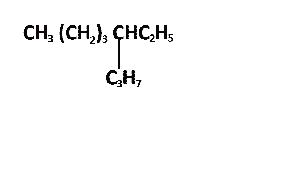
- A) 4 - ethyloctane
- B) 5 - ethyloctane
- C) 5 - propylheptane
- D) 3 - propylheptane
Which of the following is arranged in order of increasing electronegativity?
- A. Chlorine, aluminium, magnesium, phosphorus, sodium
- B. sodium, magnesium, aluminium, phosphorus, chlorine
- C. Chlorine, phosphorus, phosphorous, aluminium, magnesium, sodium
- D. Sodium, chlorine, phosphorus, magnesium, aluminium
An organic compound has the empirical formula CH2. If its molar mass is 42gmol−1, what is its molecular formula? (C = 12.0, H = 1.0)
- A. C2H4
- B. C3H4
- C. C3H6
- D. C4H8
(a)(i) Give two differences between a conductor and an electrolyte.
(ii) State three applications of electrolysis.
(iii) Write equation for the reaction at each electrode when a dilute solution of sodium chloride is electrolysed using carbon electrodes.
(b)(i) What is an electrochemical cell?
(ii) Give two examples of primary cells.
(iii) Split the following equation into two balanced hall cell equations. Mte + Fe\(^{2+} \to Mg^{2+} + Fe\).
(c)(i) A current of 0.72 amperes was passed through dilute tetraoxosulphate (VI) acid for 3 hours 20 minutes. Calculate the quantity of electricity that was passed
(ii) If 1 dm\(^3\) of gas evolved at the cathode during the electrolysis of acidified water, what was the volume of gas evolved at the anode?
(d)(i) 20g of copper(II) oxide was warmed with 0.05 mole of tetraoxosulphate (VI) acid. Calculate the mass of copper (II) oxide that was in excess. The equation for the reaction: CuO\(_{(s)}\) + H\(_2\)SO\(_{4(aq)}\) ---> CuSO\(_{4(aq)}\) + H\(_2\)O\(_l\) [0 = 16 ; Cu = 64]
(ii) What type of reaction was involved in (d)(i)?
View Discussion (0)WAEC 1999 THEORYWhich ONE of the following statements is true for the p-block elements?
- A) electro-negativity increases as we go down a group
- B) electro-negativity increases regularly from left to right across a period
- C) electro-negativity decreases regularly from left to right across a period
- D) electro-negativity remains almost constant across a period
Which of the following metals is commonly alloyed with copper to make brass?
- A. Iron
- B. Nickel
- C. Aluminum
- D. Zinc
If 24.83cm3 of 0.15M NaOH is titrated to its end point with 39.45cm3 of HCI. what is the molarity of the HCl?
- A) 0.094M
- B) 150M
- C) 0.940M
- D) 1.500M