

Chemistry Past Questions And Answers
________ is due to the formation of hydrogen gas bubbles around the copper plate of a simple cell
- A) polarization
- B) depolarization
- C) local action
- D) amalgamation
The most suitable process of obtaining water from an aqueous solution of sugar i
- A. Crystallization
- B. Distillation
- C. Filtration
- D. Decantation
In the diagram below, X is the
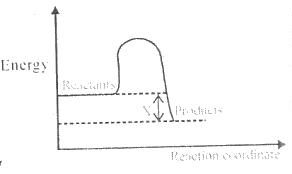
- A) Enthalphy
- B) Activated complex
- C) Activation energy
- D) Enthalphy change
Starch undergoes complete hydrolysis to produce
- A. maltose
- B. lactose
- C. fructose
- D. glucose
What amount of mercury would be liberated if the same quantity of electricity that liberates 0.65g of zinc is applied?
- A. 2.01g
- B. 1.00g
- C. 4.02g
- D. 8.04g
Which of the following exhibits resonance?
- A. Benzene
- B. Butane
- C. Pentene
- D. Octana
The salt formed from a reaction between citric acid and sodium hydroxide in solution will be
- A) acidic
- B) basic
- C) complex
- D) neutral
0.46g of ethanol when burned raised the temperature of 50g of water by 14.3K. Calculate the heat of combustion of ethanol. [C = 12, O = 16, H = 1, Specific heat capacity of water = 4.2 jg-1K-1]
- A. +3000 KJ mol-1
- B. +300 KJ mol-1
- C. -300 KJ mol-1
- D. -3000 KJ mol-1
Rare gases are stable because they
- A. contain equal number of protons and neutrons
- B. contain more electrons than protons
- C. are chemically active
- D. have octet structure
Which of the following titrations will have a solution with a pH greater than 7 at the end point (equivalent point) of the titration?
- A) titration of sodium hydroxide with tetraoxosulphate (VI) acid
- B) titration of sodium trioxocarbonate (IV) with hydrochloric acid
- C) titration of sodium hydroxide with oxalic acid (ethanedioic acid)
- D) titration of ammonium hydroxide and trioxonitrate (V) acid