

Chemistry Past Questions And Answers
a. Starting with calcium chloride, describe briefly how a solid sample of calcium trioxocarbonate (IV) can be prepared in the laboratory.
b. With relevant equations outline the procedure for the purification of impure copper.
c. Copper reacts with concentrated trioxonitrate (V) acid: i. write a balanced chemical equation for the reaction;
ii. state what would be observed in the reaction,
iii. state why the copper is oxidized;
iv. an excess of copper is added to 25.0 \(cm^3\) of 16.0 mol \(dm^3\) \(HNO_3\). Calculate the volume of the gas formed at s.t.p. [H=1.0, N=14.0, O= 16.0, Cu=63.0; Molar volume of gas at .s.t.p.=22.4 \(dm^3\)]
di. Pure \(HNO_3\), is a colourless liquid but when exposed to air, it turns yellowish-brown in colour. Explain briefly this observation.
ii. Write a balanced equation for the laboratory preparation of hydrogen trioxonitrate (V) acid.
View Discussion (0)WAEC 2023 THEORYIn the diagram below, which of the curves represents the evolution of oxygen with time in the equation 2KClO3(s) → 2KCl(s) + 3O2(g)?
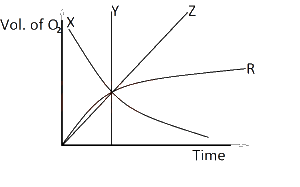
- A) X
- B) Y
- C) Z
- D) R
The substance often used for vulcanization of rubber is?
- A. Chlorine
- B. Hydrogen peroxide
- C. Sulphur
- D. Tetraoxosulphate(vi) acid
In which of the following is the oxidation number of sulphur equal to -2?
- A. S8
- B. H2S
- C. SO8
- D. SO32-
A colourless gas with a pungent smell is evolved when dilute hydrochloric acid is added to a sample of a salt. The gas evolved could turn
- A. acidified K2Cr2O7 solution colourless
- B. acidified KMnO4 solution colourless
- C. Fe(NO3)2 solution green
- D. Pb(NO3)2 paper black
In linear molecules, the bond angle is
- A. 90°
- B. 140°
- C. 109°
- D. 180°
What is the oxidation number of chromium in K2CrO4?
- A. +1
- B. +2
- C. +4
- D. +6
The gas that can be collected by downward displacement of air is
- A) chlorine
- B) sulphur (IV) oxide
- C) carbon (IV) oxide
- D) ammonia
What is the correct IUPAC name for NO-2?
- A. Dioxonitrate (IV) ion
- B. Trioxonitrate (III) ion
- C. Trioxonitrate (IV) ion
- D. Dioxonitrate (III) ion
(a) Give the electrolyte of a named secondary electrochemical cell.
(b) Consider the cell represented as shown below: \(Cu_{(s)}Cu^{2+}_{(aq)}/Zn^{2+}_{(aq)}/Zn{(s)}\)
(i) What does the vertical double stroke represent?
(ii) Which of the metals forms the cathode?
(iii) Name the electrode to which each half-cell should be coupled if the oxidation potential of the half-cells are to be determined.
View Discussion (0)WAEC 1992 THEORY