

Chemistry Past Questions And Answers
An anhydride is an oxide of non-mental?
- A. which will not dissolve in water
- B. whose solution in water has a pH greater than 7
- C. whose solution in water has a pH less than 7
- D. whose solution in water has a pH of 7
The metal extracted from cassiterite is
- A. calcium
- B. copper
- C. tin
- D. sodium
Which of the following equations does not illustrate correctly one of the reactions of chlorine?
- A. \(Ca(OH)_2 + Cl_2 → CaOCl_2 + H_2O\)
- B. \(Cl_2 + 2NaF → 2NaCl + F_2\)
- C. \(Cl_2 + 2NaOH → NaCl + NaClO + H_2O\)
- D. \(H_2S + Cl_2 → 2HCl + S\)
The isomers of C3H8O ARE
- A) 1 - propanol and 2 - propanol
- B) 1 - propanol and 1 - propanol
- C) 2 - propanol and 2 - propanone
- D) 2 - propanol and 1 - propanol
In the diagram, the function of the concentrated H2SO4 is to
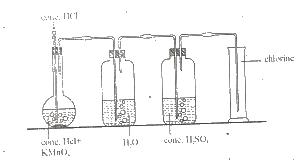
- A) purify the gas
- B) dry the gas
- C) liquefty the gas
- D) remove odour
The phenomenon observed when dust particles collide randomly in a beam of sunlight is known as
- A) Tyndal effect
- B) Diffusion
- C) Osmosis
- D) Brownian movement
The oxidation number of chlorine is + 1 in
- A. KCIO3
- B. NaCIO
- C. HCI
- D. ZnCI2
(i) Draw and label an energy profile diagram of an endothermic reaction. Indicate on your diagram the I. activation energy II. heat change, \(\Delta\)H.
(ii) Explain how the rate of reaction is affected by I. addition of a catalyst, II. increase in temperature.
(b)(i) Write an equation for the thermal decomposition of calcium trioxocarbonate (IV)
(ii) Determine the volume of carbon (IV) oxide measured at s.t.p. that would he produced by the thermal decomposition of 10g calcium trioxocarbonate (IV). [ Ca = 40; O = 16; C = 12 ]
(c)(i) Give one use cf each of the following forms of carbon: I. coal; II. wood charcoal; Ill. carbon (IV) oxide.
(ii) Write a balanced chemical equation to show what happens when each of the following compounds is heated strongly: I. NaNO\(_{3(s)}\) II. MgCO\(_{3(s)}\).
(d) Consider the following compounds: CaO, CaCO\(_3\), Ca(OH)\(_2\), NaOH Which of them is
(i) used in the manufacture of cement;
(ii) used to detect the presence of carbon (IV) oxide;
(iii) used to liberate carbon (IV) oxide when dilute acid is added;
(iv) hygroscopic;
(v) deliquescent?
View Discussion (0)WAEC 2007 THEORYWhen acidified KMnO4 solution is decolorised by ethene, the gas acts as
- A. a straight-chain hydrocarbon
- B. a saturated hydrocarbon
- C. a reducing agent
- D. a dehydrating agent
In which of the following are the substances arranged in their correct order of increasing melting point?
- A. Sodium chloride, sulphur, diamond
- B. Diamond, sodium chloride, sulphur
- C. Sulphur, sodium chloride, diamond
- D. Diamond, sulphur, sodium chloride