

Chemistry Past Questions And Answers
Which of the following factors characterize members of the same homologous series?
- A. The chemical property change gradually throughout the series
- B. physical properties of members are similar
- C. They have the same molecular formular
- D. Successive members undergo changes in molecular formula by CH2
(a) Explain briefly why \(_2^4He\) has a stable electron configuration compared to \(_4^9Be\)
(b) Consider the following elements: 1H and 3Li.
(i) State the number of electrons that an atom of each element would have after forming an ionic bond.
(ii) Give a reason for each of your answers stated in (b)(i).
(c) Statetwo factors that should be considered when siting a chemical industry.
(d) Statetwo advantages of using a catalyst instead of high temperatures in chemical reactions.
(e) Turpentine burns in chlorine according to the following equation:
C\(_{10}\)H\(_{16}\)\(_{(I)}\) + 8Cl\(_{2(g)}\) \(\to\) 10C\(_{(s)}\) + 16HCl\(_{(g)}\)
Calculate the mass of turpentine that would completely burn in 21.3 g of chlorine.
[Molar mass of chlorine = 71 gmol\(^{-1}\); Molar mass of Turpentine = 136 gmol\(^{-1}\)]
(f) What is cracking?
(g) Statetwo factors that may influence the value of electron affinity.
(h) What are carbohydrates?
(i) Statetwo differences between a simple sugar and starch.
(j) Write an equation to show the dissociation ofeach of the following acids:
(i) H\(_2\)CO\(_3\);
(ii) CH\(_3\)COOH.
View Discussion (0)WAEC 2019 THEORYA few drop of conc HCL are added to about 10cm^3 of a solution of PH 3.4. The PH of the resulting mixture is?
- A. less than 3.4
- B. greater than 3.4
- C. unaltered
- D. the same as that of the pure water
If the difference between the electronegativities of two elements is large, the type of bond that can be formed between them is
- A. covalent
- B. dative
- C. ionic
- D. metallic
The group that oxygen belongs to is collectively called
- A) allotropes
- B) halogens
- C) chalcogens
- D) alkenes
(a)(i) Define the term addition polymerization
(ii) What type of organic compounds undergo addition polymerization
(iii) List two factors which affect the strength of polymers
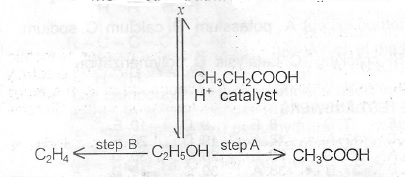
(b) The diagram below shows some reaction pathways involving ethanol
(i) Write the name and structural of the organic product X
(ii) State the reagent for the conversation indicated as step A.
(iii) What type of reaction will ethanol undergo CH\(_3\)CH\(_2\)COOH during the process of conversation indicated as step B?
(c)(i) Write three balanced equation for the complete combustion of ethanol in :date the volume of oxygen required at s.t.p for the complete combustion of ethanol. (H = 1, C = 12, O = 16, molar volume of gases at s.t.p. = 22.4 dm\(^3\))
(d)( i} State two substances produced when coal is heated in the absence of air
(ii) What name is given to the process in (d)(i) above?
(iii) State the importance of the non-volatile residue of the process named in (d)(iii) to the iron and steel industry.
Which of the following statements is true of sulphur (IV) oxide?
- A. It forms tetraoxosulphate (VI) acid with water
- B. It is an odourless gas
- C. It is an acid hybride
- D. It forms white precipitate with acidified barium chloride
(a) Give one example of naturally-occurring acids
(b) If 0.5 mole of a mono-alkanoic acid weighs 44g, determine the molecular formula and the name of the acid. (H = 1, C = 12, O = 16)
View Discussion (0)WAEC 1992 THEORY(a) State three reasons why air is classified as a mixture.
(b) List two methods that can be used to separate a mixture of iodine crystals and iron filings.
View Discussion (0)WAEC 1995 THEORYThe constituent of air necessary in the rusting process are
- A) O2 and H2O
- B) Ar and CO2
- C) CO2 and H2O
- D) O2 and CO2