

Chemistry Past Questions And Answers
MgO does not readily dissolve in water because
- A. of its high melting point
- B. it is a covalent compound
- C. it forms a hydroxide when dissolved in water
- D. its lattice energy is higher than its hydration energy
Which of the following acids would form normal salt only?
- A. Tetraoxosulphate(VI) acid
- B. Trioxonitrate(V) acid
- C. Tetraoxophosphate(V) acid
- D. Trioxosulphate(IV) acid
Atoms of element X (with 2 electrons in the outer shell). combine with atoms of Y (with 7 electrons in the outer shell). Which of the following statements is FALSE? The compound formed?
- A. has formula XY
- B. is likely to be ionic
- C. contains X2+ ions
- D. contains Y- ions
A hydrocarbon contained 14.3% hydrogen. The empirical formula for the hydrocarbon is [H= 1.0, C= 12.0]
- A. CH
- B. CH2
- C. CH3
- D. CH4
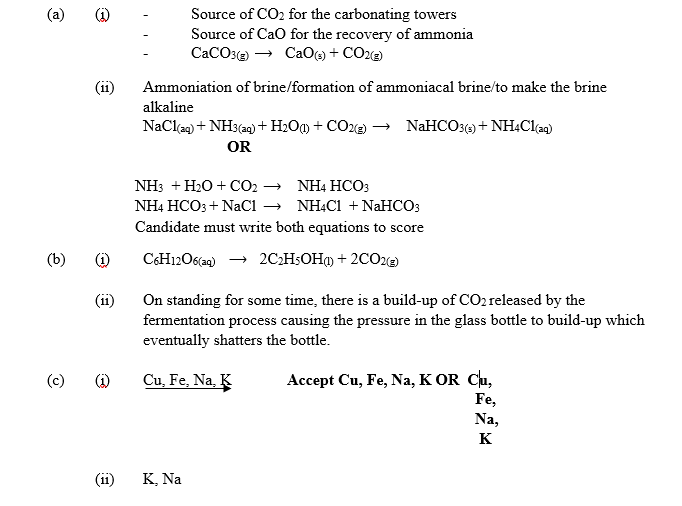
(a) In the Solvay process, explain briefly with equations the functions of the following substances:
- limestone;
- ammonia.
(b) (i) Write a chemical equation for the fermentation of glucose.
(ii) Explain briefly why a tightly-corked glass bottle filled to the brim with fresh palm-wine shatters on standing for some time.
(c) Consider the following metals: Na, Fe, K and Cu.
(i) Arrange the metals in order of increasing reactivity.
(ii) Which of the metals will react with cold water?
(ii) Which of the metals could form coloured salts?
(d)(i) What is aredox reaction?
(ii) Identify which of the following reaction equations are redox.
(I) 2Na + Cl\(_2\) → 2NaCl
(II) AgCl + 2NH\(_3\) → [Ag(NH\(_3\))\(_2\)]Cl
(III) C\(_2\)H\(_2\) + H\(_2\) → C\(_2\)H\(_4\)
(IV) HCl + KOH → KCl + H\(_2\)O
(V) 2FeCl\(_3\) + 2KI → 2FeCl\(_2\) + 2KCl + I\(_2\)
(iii) Give a reason for each of the answers in(d)(ii).
(iv) Write balanced equations of the half reactions for any two of the redox reactions in(d)(ii).
Two cylinders A and B each contains 30 cm3 of oxygen and nitrogen respectively at the same temperature and pressure. If there are 5.0 moles of nitrogen, then the mass of oxygen is?
- A. 3.2 g
- B. 6.4 g
- C. 80.0 g
- D. 160.0 g
Which of the following compounds is an example of an electrovalent bond?
- A. NaCl (sodium chloride)
- B. CO2 (carbon dioxide)
- C. H2O (water)
- D. CH4 (methane)
The greenhouse effect is a climatic condition associated with the presence of excess
- A) CO2
- B) H2S
- C) NO
- D) NH3
Which of the following factors does NOT affect the rate of a chemical reaction?
- A. Concentration of reactants
- B. Presence of a catalyst
- C. Molecular weight of products
- D. Temperature
Atomic orbital is
- A. the circular path through which electrons revolve round the nucleus
- B. a region around the nucleus where electrons are most likely to be found
- C. the path around the nucleus through which electrons move
- D. the path around the nucleus through which protons move