

Chemistry Past Questions And Answers
Which of the following shows little or no net reaction when the volume of the system is decreased?
- A)\(2O_{3(g)} \Leftrightarrow 3O_{2(g)}\)
- B)\(2NO_{2(g)} \Leftrightarrow N_2O_{4(g)}\)
- C)\(H_2 + I_{2(g)} \Leftrightarrow 2HI_{(g)}\)
- D)\(PCl_{5(g)} \Leftrightarrow PCl_{3(g)} + Cl_{2(g)}\)
N2O4(g) ↔ 2NO2(g) In the endothermic reaction above, more product formation will be favoured by
- A. a constant volume
- B. an increase in pressure
- C. a decrease in pressure
- D. a decrease in volume
Carbon is deposited in the exhaust pipes of cars because of
- A. presence of additives in petrol
- B. incomplete combustion of petrol
- C. presence of carbon in petrol
- D. contamination of petrol with diesel
The product of the reaction between propanoic acid and ethanol is
- A. prophlmethanoate
- B. ethylethanoate
- C. methylpropanoate
- D. ethylpropanoate
In the industrial production of hydrogen from natural gas, carbon (IV) oxide produced along with the hydrogen is removed by?
- A. washing under pressure
- B. passing the mixture into lime water
- C. using ammoniacal copper (l) chloride
- D. drying over phoshorus (V) oxide
An electron can be added to a halogen atom to form a halide ion with?
- A. 8 valence electrons
- B. 7 valence electrons
- C. 2 valence electrons
- D. 3 valence electrons
In a fixed volume of a gas, an increase in temperature results in an increase in pressure due to an increase in the
- A. number of the collisions between the gas molecules and the walls of the container
- B. kinetic energy of the gas
- C. number of collisions between the gas molecules
- D. number of repulsion between the gas molecules
The IUPAC nomenclature for the compound above is
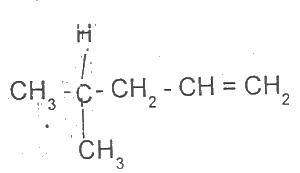
- A) 4-methylpent-1-ene
- B) 3-methylpent-2-ene
- C) 2-methylpent-1ene
- D) 2-methylpent-4-ene
The principle of column chromatography is based on th ability of the constituents to
- A) React with the solvent in the column
- B) React with each other in the solvent in the column
- C) Dissolve in each other in the column
- D) Move at different speeds in the column
In which of the following processes are larger molecules broken down into smaller molecules?
- A. Vulcanization of rubber
- B. Hydrogenation of palm oil
- C. Hydrolysis of starch
- D. Polymerization