

Chemistry Past Questions And Answers
Which of the following solids has a network structure?
- A) diamond
- B) iodine
- C) sulphur
- D) graphite
What is the maximum number of electrons that can occupy the second energy level (n=2)?
- A. 2 electrons
- B. 18 electrons
- C. 8 electrons
- D. 32 electrons
How many moles of oxygen molecules would be produced from the decomposition of 2.50 moles of potassium trioxochlorate (V)?
- A. 2.50
- B. 3.50
- C. 3.75
- D. 7.50
(a)(i) Name two gases that could be used to perform the fountain experiment.
(ii) State the physical property which makes the gases suitable for the experiment in (a)(i)
(b)(i) Define each of the following terms: I. solubility; II. saturated solution.
(ii) State two factors that affect the solubility of a solid in a liquid.
(iii) A salt Z of mass 10.2 g was dissolved in 15.4 cm\(^3\) of distilled water at 40°C. Calculate the solubility of Z in moldm\(^3\) at 40°C. [Mr (Z) = 331].
(c)(i) Town water supplies that have passed through iron pipes contain P and Q ions. In the presence of air, P ions are slowly converted to Q ions.
I. Identify P and Q ions. II. Write a balanced equation for the reaction between P ions, hydrogen ions and oxygen to give Q ions and water.
(ii) Explain briefly a test to confirm the purity of water.
(iii) State the effect of:
I. boiling a temporally hard water. II. adding sodium trioxocarbonate (IV) crystals to permanent hard water;
(iv) Write a balanced equation for the process in (c)(iii)I.
View Discussion (0)WAEC 2015 THEORYWhich of the following statements about the cell notation Mg/Mg2+//Cu2+/Cu is correct?
- A. copper is the anode
- B. Manesium is reduced
- C. Magnesium is the anode
- D. The double line represents the electrodes
(a) Give the products of the following reactions:
(i) hydrolysis of simple proteins.
(ii) alkaline hydrolysis of fats and oils.
(b) A combustion tube was packed with small pieces of broken clay pot and the tube maintained at a temperature of 750K. When the vapour of decane was passed into the tube, the main products included a gaseous hydrocarbon X.
(i) Name the process involved in the reaction. Give its industrial application.
(ii) State the function of the pieces of broken pot in the experiment.
(iii) Give one chemical test to distinguish between X and methane.
(iv) Draw a labelled diagram for the laboratory preparation of X.
(c)(i) State what would be observed if a piece of sodium was added to 10cm\(^3\) of propanol in a beaker. Write an equation for the reaction.
(ii) Give the main product formed when excess acidified potassium heptaoxodichromate (VI) reacts with each of the following: propan-1- ol: propan - 2 -of; State the type of process involved in the reactions.
View Discussion (0)WAEC 1992 THEORYThe graph below demonstrate the effect of
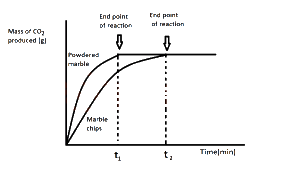
- A) surface area on the rate of reaction
- B) catalyst on the rate of reaction
- C) pressure on the rate reaction
- D) concentration on the rate of reaction
(a)(i) Define oxidation in terms of electron transfer.
(ii) Write balanced equations for the half reactions for the following changes in acidic solution: Mn0\(^-_4\) + Fe\(^{2+}\) —> Mn\(^{2+}\) + Fe\(^{3+}\)
(b)(i) Distinguish between an electrolytic celI and an electrochemical cell.
(ii) Sketch a cell for the electrolysis of molten magnesium chloride. Lable the anode and the cathode and indicate the direction of electron flow. Give the electrode reactions.
(iii) Give one reason why a platinum anode is not suitable for the eloctrolysis in (b)(i) above.
(c) Calculate the mass of lead that would be deposited from a solution of lead (II) trioxonitrate by the same quantity of electrically depositing 1.35g of copper. (Cu = 63.5, Pb = 207)
View Discussion (0)WAEC 1990 THEORY(a)(i) Outline a suitable procedure for the preparation of ZnCl\(_2\) crystals stating from zinc granules.
(ii) Write a balanced equation for the reaction in (a)(i).
(b) Considei' the following solutions: Na\(_2\)SO\(_{4(aq)}\), CH3COOK\(_{(aq)}\), Pb(NO\(_3\))\(_{2(aq)}\) and MgCl\(_2\). Which of them has/have a pH
(i) greater than 7;
(ii) equal to 7;
(iii) less than 7?
(c)(i) Determine the oxidation number of Mn in I. MnO\(_2\); II. KMnO\(_4\).
(ii) State one laboratory use of each of the .compounds in (c)(i).
(d) Explain why oxidation and reduction processes are complementary.
(e) Consider the reaction represented by the equation: Fe\(_{(s)}\) + 2Ag\(^+_{(aq)}\) \(\to\) Fe\(^{2+}_{(aq)}\) + 2Ag\(_{(s)}\)
(i) Write a balanced ionic half equations for the reaction.
(ii) Which of the species is I. oxidized; II. reduced?
(iii) State the change in the oxidation number of silver during the reaction.
View Discussion (0)WAEC 2009 THEORYWhich of the following bonds are broken when ethanol is boiled? I. Covalent bonds II. Ionic bonds III. Hydrogen bonds
- A. I only
- B. II only
- C. III only
- D. I, II, III