

Chemistry Past Questions And Answers
200cm3 of hydrogen were collected over water at 30 °C and 740mmHg. Calculate the volume of the gas at s.t.p. if the vapour pressure of water at the temperature of the experiment is 14mmHg.
- A) 168.25cm3
- B)176.40cm3
- C) 185.46cm3
- D) 172.14cm3
Which of the following is a neutralization reaction?
- A) nitric acid to hydrochloric acid
- B) nitric acid to sulphuric acid
- C) nitric acid to distilled
- D) nitric acid to sodium hydroxide
(a) What are nucleons?
(b) State Graham's law of diffusion.
(c) Explain briefly why aluminium does not corrode easily.
(d) State three examples of periodic properties.
(e) State two reasons why real gases deviate from ideal gas behaviour.
(f) List three uses of fractional distillation in industry.
(g) What factors determine the selective discharge of ions at the electrodes during electrolysis?
(h) State the type of reaction represented by each of the following equations:
(i) C\(_2\)H\(_6\) + Br\(_2\) ---> C\(_2\)H\(_5\)Br + HBr;
(ii) C\(_2\)H\(_4\) + .Br\(_2\) ---> CH\(_4\)Br\(_2\)
(i) Name the products formed when butane burns in limited supply of air.
(j) List three methods of separating a solid from a liquid.
View Discussion (0)WAEC 2016 THEORYWhich Gospel includes the account of Jesus washing the disciples' feet during the Last Supper?
- A. Matthew
- B. Luke
- C. John
- D. Mark
In the diagram below, Y is
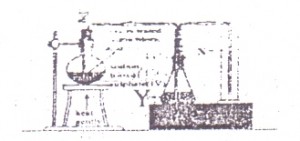
- A) fused CaO
- B) H2O
- C) NaOH
- D) Concentrated H2SO4
consider the following reaction equation: 2Al(OH)3 + 3H2SO4 →Al2(SO4)3(aq)+6H2O. How many moles of tetraoxosulphate(vi)acid is needed to produce 0.5mol of aluminium tetraoxosulphate(vi)?
- A. 0.5
- B. 1.0
- C. 1.5
- D. 3.0
The bond formed between two elements with electron configurations 1s2 2s2 2p6 3s2 and 1s2 2s2 2p4 is
- A) metallic
- B) covalent
- C) dative
- D) ionic
which of the following carbohydrate does not usually occur in the crystalline form?
- A. Cellulose
- B. sucrose
- C. maltose
- D. fructose
M(s) ?+ xH2SO4(aq) \(\rightarrow\) M(SO4)x(aq) ?+ xH2(g) ?Which of the following elements will not undergo the above reaction?
- A) Zn
- B) Na
- C) Cu
- D) Ca
(a) State how you would carry out the following procedures in the laboratory:
(i) Remove the sediment in sample of water;
(ii) Soften temporarily hard water without heating it,
(iii) Obtain pure water frdm muddy water;
(iv) Remove oxygen and moisture from a sample of air
(b)(i) What type of salts are alums?
(ii) State the function of alum in water treatment plants.
(iii) State and explain how rain water that hac passed through limestone deposits will react with soap solution.
(c)(i) Write an equation for the laboraton preparation of chlorine
(ii) List the products of the reaction of chorine with hot concentrated sodiuri hydroxide solution
(iii) What is observed when moist blue litmus paper comes in contact with chlorine?
(iv) Calculate the volume of chlorine at s.t.p. that would be required to react completely with 3.70g of dry slaked lime according to the following equation:
Ca(OH)\(_{2(s)}\) + Cl\(_{2(g)}\) --> CaOCl\(_{2}\). H\(_2\)O\(_{(s)}\) [H = 1, O = 16, Ca = 40, 1 mole of gas occupies 22.4 dm\(^3\) at s.t.p.]
(d)(i) State what is observed on warming ammonium trioxonitrate (V) with sodium hydroxide solution
(ii) Explain why ammonium trioxocarbonate (IV) leaves no residue on being heated.
View Discussion (0)WAEC 2000 THEORY